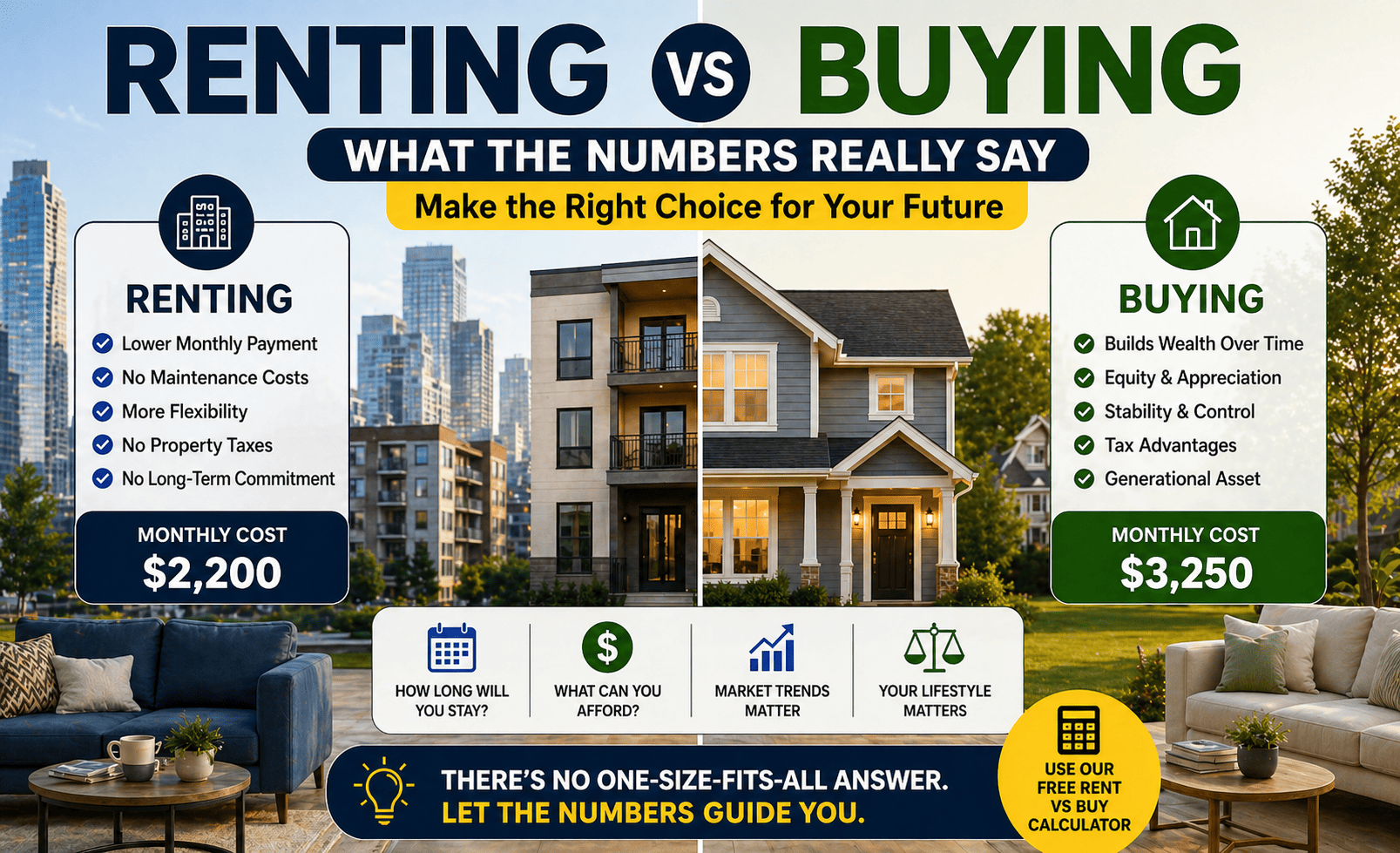
The renting vs buying debate has been going on for decades, but 2026 is a genuinely different environment than most of the previous ones. Mortgage rates are still elevated compared to the historic lows of 2020–2021. Home prices remain stubbornly high in most US markets. And yet rent isn’t cheap either. The average US renter is paying substantially more than they were five years ago.
The honest answer to “should I rent or buy?” is: it depends on the numbers specific to your situation, your local market, how long you plan to stay, what you’d do with a down payment otherwise, and how much you value flexibility vs stability. What doesn’t work is comparing your monthly rent to a mortgage payment and calling it even. Those two numbers leave out the majority of the real financial picture on both sides.
This article breaks down every cost that actually matters in the rent vs buy comparison, shows you what the numbers look like in real scenarios for 2026, and gives you a clear framework for making the decision based on your own situation.
Why the Simple Rent vs Mortgage Comparison Fails
The most common mistake people make is comparing their monthly rent to what a mortgage payment would be on the same property. It feels intuitive, if the mortgage is lower than rent, buy; if it’s higher, keep renting. But this comparison misses most of what actually determines whether renting or buying leaves you better off financially.
On the buying side, the mortgage payment is just one of many costs. Add property taxes, homeowner’s insurance, maintenance and repairs, HOA fees where applicable, closing costs at purchase, and potentially PMI if your down payment is under 20%. In most US markets, the true all-in monthly cost of owning a home runs 30–50% higher than the principal and interest payment alone.
On the renting side, the picture is also more complex than it appears. Rent typically increases every year. You’re not building equity. But you also have no maintenance costs, more flexibility, and if you have a down payment saved, the ability to invest that money in assets that may grow.
The True Cost of Renting
Renting is often dismissed as “throwing money away,” a phrase that’s technically wrong but points to something real. You’re not building equity. But that doesn’t mean renting is financially irrational. It means the comparison needs to account for more than the monthly payment.
What renting actually costs
- Monthly rent: The base payment, which increases typically 3–5% per year in most US markets
- Renter’s insurance: Roughly $15–$30/month, far cheaper than homeowner’s insurance
- No maintenance costs: Appliance failures, roof repairs, HVAC replacement, all the landlord’s problem
- No property tax: Included in the rent but not a direct liability
- No closing costs: Move in and out without transaction fees
- Opportunity cost of the down payment: This is the hidden cost most renters don’t model, if you have $80,000 that could be a down payment, what does it earn invested instead?
The opportunity cost of the down payment is the most underappreciated factor in the rent vs buy analysis. $80,000 invested in a diversified index fund at a historical average return of 7% grows to approximately $222,000 over 15 years. That growth belongs in the cost comparison, it’s what you give up when you put that money into a down payment instead.
The True Cost of Buying
Buying a home involves layers of costs that compound over time and most buyers only think about the mortgage payment when making the decision.
Upfront costs
- Down payment: Typically 10–20% of the purchase price. On a $420,000 home, that’s $42,000–$84,000 in cash.
- Closing costs: Typically 2–5% of the loan amount, another $8,000–$20,000 on a $400K purchase. This money is gone from day one regardless of what happens to the home’s value.
- Moving costs and immediate repairs: Often $2,000–$10,000 in the first year for new homeowners
Ongoing monthly costs
- Mortgage P&I: The base payment, but not the whole story
- Property taxes: Typically 1–2% of home value annually. On a $420K home that’s $350–$700/month
- Homeowner’s insurance: Typically $100–$200/month
- PMI: If down payment is under 20%, typically 0.5–1.5% of loan annually, $175–$525/month on a $420K loan
- HOA fees: $0–$500+/month depending on property type and location
- Maintenance and repairs: The standard estimate is 1% of home value per year, $350/month on a $420K home. This is often undercounted until a major repair hits.
Many financial planners suggest budgeting 1% of home value annually for maintenance. On a $420,000 home that’s $4,200/year. But older homes, homes in harsh climates, and homes with deferred maintenance can easily run 2–3%. A single HVAC replacement ($5,000–$12,000), roof repair ($8,000–$20,000), or foundation issue ($10,000–$50,000) can wipe out years of equity gains. New homeowners consistently underestimate this number.
Real Numbers: Renting vs Buying in 2026
Let’s model a direct comparison in a mid-range US market. Assume a $400,000 home, 10% down payment ($40,000), 30-year mortgage at 6.75%, and a comparable rental at $2,200/month. We’ll model a 7-year hold period, long enough for buying to start showing its advantages, but realistic for many homeowners.
In this scenario after 7 years, the renter is about $54,000 better off on a pure cash-flow basis, but has no equity and no asset. The buyer has spent more but owns roughly $95,000 in equity (principal paid down plus modest appreciation). Whether buying “wins” depends on what you value: the equity asset or the cash flow flexibility.
If that home appreciates at 4% annually over 7 years, its value grows from $400,000 to approximately $527,000, adding another $127,000 in appreciation on top of the equity from principal paydown. At that point, buying wins decisively. If appreciation is flat or negative, renting wins. Home appreciation is the single biggest variable in the rent vs buy calculation and it’s the one you can’t control.
The Break-Even Point: How Long Do You Need to Stay?
One of the most useful outputs of a rent vs buy analysis is the break-even point, the number of years you need to stay in a home before the financial benefits of buying outweigh the costs. Before that point, you’d have been better off renting. After it, buying pulls ahead.
The break-even timeline varies enormously depending on your local market, mortgage rate, and the rent-to-price ratio in your area. But as a general framework in 2026’s rate environment:
| Market Type | Typical Break-Even | Key Driver |
|---|---|---|
| High cost-of-living (NYC, SF, LA) | 8–12+ years | High purchase price relative to rent; buying very expensive upfront |
| Mid-tier cities (Austin, Denver, Nashville) | 5–8 years | Moderate price-to-rent ratios; appreciation has been strong |
| Affordable markets (Midwest, South) | 3–5 years | Lower home prices relative to rent; buying becomes competitive faster |
| High appreciation markets | 3–6 years | Appreciation accelerates equity build-up, shortening break-even |
| Flat/declining markets | 10–15+ years | Without appreciation, buying costs dominate for many years |
The practical implication: if you’re not planning to stay in a location for at least 5 years, renting is almost always the financially safer choice. The closing costs alone, typically 2–5% of the purchase price, take years to recoup through equity build-up and appreciation.
Home Equity vs Investing Your Down Payment
The question of what you’d do with the down payment if you rented instead of buying is one of the most important and most honestly argued points in the rent vs buy debate.
A $60,000 down payment (15% on a $400K home) invested in a diversified index fund has historically grown at roughly 7% annually over long periods. Over 10 years that becomes approximately $118,000. Over 20 years, approximately $232,000. These are real numbers that belong in the comparison.
Scenario A – Buy: $60,000 down payment on $400K home. After 10 years at 3% annual appreciation, home worth ~$537,000. Remaining mortgage balance ~$313,000. Equity: ~$224,000.
Scenario B – Rent and invest: $60,000 invested at 7% annual return grows to ~$118,000. Plus 10 years of renting at $2,200/month (3.5% annual increase) vs owning at $3,400/month equivalent. Cash flow savings: roughly $85,000 over the period.
Verdict: Buying produces more wealth in this scenario, but only because of home appreciation. Remove appreciation and the renter comes out ahead. The outcome is genuinely uncertain, and both paths can be financially sound depending on your market and discipline.
The honest reality is that most renters don’t actually invest the difference. The mental accounting that says “I’m saving $1,200/month by renting instead of buying” rarely translates into $1,200/month actually going into investments. If you’re disciplined enough to invest consistently, the renter’s case is stronger. If the money would otherwise be spent, the forced savings nature of a mortgage, each payment builds equity, has real value.
Why Your Local Market Changes Everything
National averages are useful for context but nearly useless for making your personal decision. The rent vs buy math in San Francisco looks nothing like the math in Columbus, Ohio. The single most important variable is the price-to-rent ratio in your specific market.
The price-to-rent ratio is calculated by dividing the home purchase price by the annual rent for a comparable property. A ratio above 20 generally favours renting; below 15 generally favours buying; between 15 and 20 is a judgement call depending on your other factors.
| City | Median Home Price | Median Monthly Rent | Price-to-Rent Ratio | Generally Favours |
|---|---|---|---|---|
| San Francisco, CA | ~$1,200,000 | ~$3,200 | 31 | Renting |
| Austin, TX | ~$530,000 | ~$1,900 | 23 | Renting (borderline) |
| Phoenix, AZ | ~$430,000 | ~$1,750 | 20 | Borderline |
| Columbus, OH | ~$290,000 | ~$1,450 | 17 | Buying (borderline) |
| Memphis, TN | ~$210,000 | ~$1,300 | 13 | Buying |
These ratios explain why “is it better to rent or buy?” has different answers depending entirely on where you live. In San Francisco, buying requires massive upfront capital and the ongoing cost of ownership is dramatically higher than renting a comparable place. In Memphis, the monthly cost of owning is often competitive with renting, and the equity build-up becomes meaningful much faster.
Calculate Renting vs Buying for Your Specific Market
Enter your local rent, home price, expected appreciation, and how long you plan to stay, get a side-by-side financial comparison showing which option comes out ahead and by how much.
Run My Rent vs Buy Comparison →When Renting Is the Smarter Financial Choice
Renting isn’t a consolation prize. In the right circumstances, it’s the financially superior decision and pretending otherwise costs people real money.
- You’re staying fewer than 5 years. Closing costs, transaction fees at sale, and the front-loaded interest structure of mortgages mean buying and selling within a short window almost always loses money compared to renting.
- Your local price-to-rent ratio is above 20. In high-cost markets, the monthly cost of ownership is so much higher than renting that appreciation would have to be exceptional to close the gap.
- You have high-interest debt. Paying off credit cards at 20%+ before buying a home at 6.5–7% is the mathematically correct order. The mortgage rate advantage doesn’t overcome high-interest debt.
- Your emergency fund is thin. Buying a home without a solid cash buffer is financially dangerous. A $15,000 HVAC or roof repair has to come from somewhere and if it’s a credit card, the cost of homeownership just went up dramatically.
- Your income or job situation is unstable. A mortgage is a fixed obligation. Renting gives you the option to downsize quickly if income drops. The flexibility has real financial value that pure cost comparisons don’t capture.
- You’d invest the down payment and the monthly difference. If you have the discipline to consistently invest both, the financial case for renting in a high-ratio market is genuinely strong.
When Buying Makes Financial Sense
Buying a home isn’t always the right move, but when the conditions align, it produces long-term wealth in a way that renting doesn’t match.
- You’re staying 7+ years. Long hold periods are where buying’s advantages compound, equity builds, appreciation accumulates, and the upfront costs get amortised over more time.
- Your local price-to-rent ratio is below 15–17. In affordable markets, the monthly cost of owning is competitive with renting, and the equity build-up comes faster.
- You have a stable income and fully-funded emergency fund. These are preconditions for homeownership that aren’t optional, they’re what allow you to absorb the inevitable large expenses without financial stress.
- Rent is rising fast in your market. A fixed-rate mortgage locks in your principal and interest payment for 30 years. If local rents are rising 5–7% annually, your housing cost stability becomes increasingly valuable over time.
- You have a down payment of at least 10–20%. Buying with less than 10% down means PMI, higher rates, and very little equity buffer if prices soften. The numbers start to work much better above 20% down.
- You value stability and control. The ability to renovate, paint walls, keep pets, and not receive a lease non-renewal has financial value even if it doesn’t show up in a spreadsheet.
The Non-Financial Factors That Actually Matter
Any honest treatment of the rent vs buy decision has to acknowledge that this isn’t purely a financial calculation. People make this decision with their lives, not just their spreadsheets, and that’s completely valid.
Factors that favour buying beyond the numbers
- Stability for a family. School district continuity, community roots, and the ability to stay put without lease uncertainty have real value for families with children, value that doesn’t appear in a financial model.
- Control over your space. The ability to renovate, maintain the property to your standards, keep pets without restrictions, and make the space genuinely yours is meaningful for many people.
- Protection against rent increases. A fixed-rate mortgage eliminates housing cost uncertainty over the long term. For people who value predictability in their finances, this matters.
- Psychological ownership. Many people derive genuine wellbeing from owning their home, a sense of security and permanence that renting doesn’t provide. This isn’t irrational; it’s a real preference with real value.
Factors that favour renting beyond the numbers
- Geographic flexibility. Career opportunities, family changes, or lifestyle shifts may require relocating. Renting allows this with a 30–60 day notice. Selling a home takes months and costs 6–10% of the sale price in transaction costs.
- Freedom from maintenance. For some people, the responsibility of homeownership, the weekend repairs, the contractor calls, the unexpected expenses, is a genuine quality-of-life negative that the financial analysis doesn’t capture.
- Lower complexity. Renting is simpler. No property tax filings, no homeowner’s insurance claims, no mortgage refinancing decisions, no HOA disputes. For people who value simplicity, this has real worth.
See Which Option Wins in Your Market
Enter your rent, local home price, down payment, and how long you plan to stay to see a full comparison of renting vs buying over your timeframe, including the break-even point.
Calculate Rent vs Buy – Free Tool →