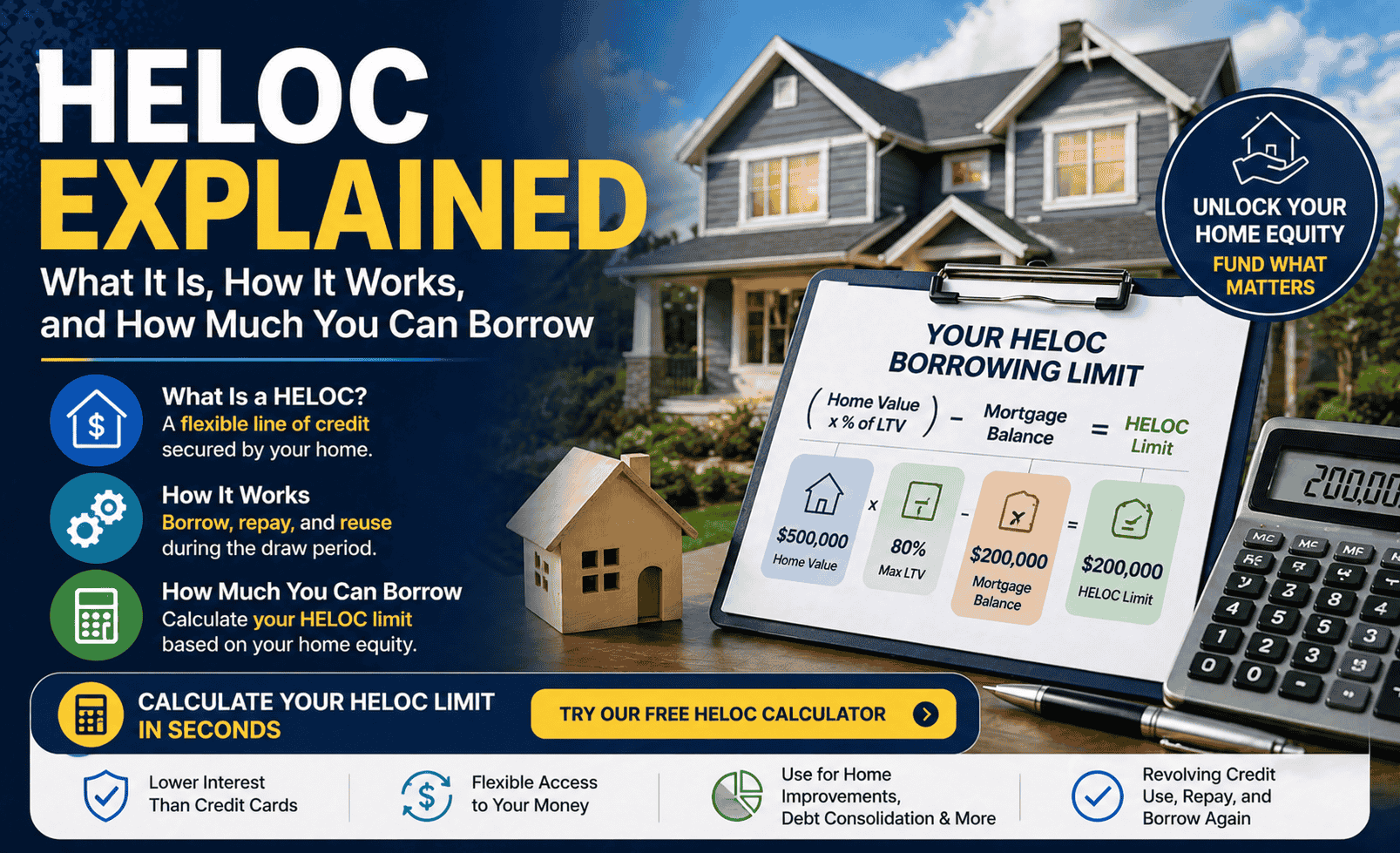
If you own a home and have been making mortgage payments for a few years, you’ve probably built up equity, the difference between what your home is worth and what you still owe. A HELOC lets you tap into that equity without selling your home or refinancing your entire mortgage. It’s one of the most flexible borrowing tools available to American homeowners, and also one of the most misunderstood.
Most people hear “line of credit” and assume it works like a credit card. That’s partially true, but the mechanics, the risks, and the costs are meaningfully different. The interest rates are variable. The payments change dramatically over time. And if you don’t plan ahead, the jump from the draw period to the repayment period can catch you off guard.
This guide covers exactly what a HELOC is, how it works in practice, what determines how much you can borrow, and what to think about before applying for one.
What Is a HELOC?
A Home Equity Line of Credit, commonly abbreviated as HELOC, is a revolving credit facility secured by your home. Unlike a traditional loan where you receive a lump sum and begin repaying it immediately, a HELOC gives you access to a credit line you can draw from as needed, repay, and draw again, similar in structure to a credit card, but at significantly lower interest rates because your home serves as collateral.
The amount you can borrow depends on how much equity you’ve built in your home. Equity is the portion of your home’s value that you actually own, calculated as the current market value of your home minus what you still owe on your mortgage. Lenders typically allow you to borrow against 80% to 85% of your home’s appraised value, minus your existing mortgage balance.
What makes a HELOC attractive is its flexibility. You’re not committed to borrowing the full amount. You draw only what you need, when you need it. If you have a $100,000 credit line and only use $30,000 of it, you pay interest only on the $30,000. This makes it well-suited for expenses that unfold over time, such as home renovations, medical costs, or tuition, rather than a single large purchase.
How a HELOC Works: Draw Period vs Repayment Period
A HELOC operates in two distinct phases, and understanding both is essential before you take one out. The payment difference between the two phases is often much larger than borrowers expect.
HELOC balance: $80,000 at 8.5% interest
Draw period payment (interest-only): approximately $567/month
Repayment period payment (20 years, P+I): approximately $694/month
That’s a 22% jump, and it arrives the moment the draw period ends, whether you’re financially ready or not. Use the HELOC calculator to model your exact payment shock before committing.
During the draw period, many borrowers make only the minimum interest-only payment. This is a choice worth thinking carefully about. The interest-only option keeps monthly costs low, but when the repayment period begins, you still owe the full principal you borrowed, and now you have to repay it all within the repayment window. Making additional principal payments during the draw period reduces that burden significantly.
How Much Can You Borrow With a HELOC?
Your HELOC borrowing limit is determined by three factors: your home’s current appraised value, your existing mortgage balance, and the lender’s maximum combined loan-to-value (CLTV) ratio, typically 80% to 85%.
The core concept is combined LTV. Lenders add your existing mortgage balance and your requested HELOC credit line together, and that combined total cannot exceed their CLTV limit as a percentage of your home’s value.
What affects your maximum borrowing limit
- Home value: The appraised value of your home. Rising home values increase your available equity; declining values reduce it.
- Mortgage balance: What you still owe on your primary mortgage. The lower your balance, the more equity you can access.
- Lender CLTV limit: Most lenders cap at 80-85%. Some go to 90%, but this typically comes with higher rates or stricter credit requirements.
- Credit score: A higher credit score may unlock a higher CLTV limit with some lenders.
- Debt-to-income ratio: Lenders also assess your overall debt load. A high DTI ratio can reduce the credit line offered even if your equity is sufficient.
The HELOC Borrowing Limit Formula
The calculation lenders use is straightforward once you understand the components.
Home appraised value: $450,000
Existing mortgage balance: $280,000
Lender CLTV limit: 85%
Maximum HELOC: ($450,000 × 85%) – $280,000 = $382,500 – $280,000 = $102,500
This homeowner could access up to $102,500 as a HELOC credit line, but the actual amount offered may be lower depending on credit score and DTI.
One important nuance: lenders use an appraised value, not your Zillow estimate or tax assessment. The appraisal is conducted as part of the HELOC application process, and if your home appraises lower than expected, your available credit line will be smaller. This is one reason it’s worth having a realistic sense of your home’s current market value before applying.
How HELOC Interest Rates Work
Most HELOCs carry variable interest rates, which is fundamentally different from most other forms of borrowing. Understanding how the rate is set and how it can change is essential to understanding the true cost of a HELOC.
Variable rate structure: Prime + Margin
HELOC rates are typically expressed as the US Prime Rate plus a lender margin. The Prime Rate is set by major US banks and moves in tandem with the Federal Reserve’s federal funds rate. When the Fed raises rates, the Prime Rate rises, and your HELOC rate rises with it, automatically usually within one billing cycle.
If the current US Prime Rate is 8.50% and your lender’s margin is 1.00%, your HELOC rate is 9.50%. If the Fed raises rates by 0.50%, the Prime Rate moves to 9.00% and your HELOC rate automatically becomes 10.00%, with no action required or notice from your lender beyond your monthly statement. On a $100,000 balance, that 0.50% increase adds roughly $42/month to your interest-only payment.
| Rate Component | Who Sets It | Typical Range | Fixed or Variable? |
|---|---|---|---|
| US Prime Rate | Major US banks (follows Fed) | Historically 3%-9%+ | Variable, changes with Fed policy |
| Lender Margin | Your specific lender | 0.50%-2.00% | Fixed for life of your HELOC |
| Your HELOC Rate | Prime + Margin combined | Currently ~7.5%-10%+ | Variable, changes when Prime moves |
Some lenders offer fixed-rate HELOCs or the ability to lock a portion of your balance at a fixed rate. This is worth asking about if you’re borrowing a large amount and concerned about rate increases. The tradeoff is typically a higher starting rate compared to a variable HELOC.
HELOC vs Home Equity Loan: Key Differences
Both products let you borrow against your home equity, but they work very differently. Choosing the wrong one for your situation can cost you significantly.
| Feature | HELOC | Home Equity Loan |
|---|---|---|
| How funds are received | Revolving credit line, draw as needed | Lump sum upfront |
| Interest rate | Usually variable (Prime + Margin) | Usually fixed |
| Payments during draw | Interest-only on amount drawn | Full P+I from day one |
| Best for | Ongoing or uncertain expenses | One-time large expense |
| Rate predictability | Low, rates change with Prime | High, fixed rate for full term |
| Flexibility | High, borrow only what you need | Low, full amount from start |
| Interest paid | Only on amount drawn | On full loan amount from start |
The general rule: if you know exactly how much you need and want payment certainty, a home equity loan is cleaner. If your expenses are spread over time or uncertain in total, a HELOC’s flexibility saves you from paying interest on funds you haven’t used yet.
What Homeowners Use HELOCs For
A HELOC is most appropriate when the borrowing serves a purpose that either builds value, reduces higher-cost debt, or addresses a genuine financial need. Here’s where HELOCs make sense and where they don’t.
Smart uses
- Home renovations and improvements. The classic HELOC use case. Improvements that increase your home’s value effectively let you borrow against equity you’re creating. Kitchen upgrades, bathroom remodels, additions, and energy efficiency improvements often qualify.
- Debt consolidation. Replacing high-interest credit card debt (often 20%+) with HELOC debt at 8-10% saves meaningful money. The risk is that you’re converting unsecured debt into debt secured by your home.
- Education expenses. Spreading tuition payments over the draw period at lower rates than private student loans can make financial sense.
- Emergency fund access. Keeping an open but undrawn HELOC as a financial safety net costs nothing until you use it.
Uses to approach with caution
- Vacations, vehicles, or consumer purchases. Borrowing against your home for depreciating assets or non-essential expenses puts your home at risk for things that don’t build financial value.
- Investment in stocks or speculative assets. Using home equity to invest in volatile assets creates a scenario where your investments can decline while your debt remains fixed.
- Covering recurring income shortfalls. If you’re using a HELOC to cover regular living expenses, it’s a sign of a structural financial problem that the HELOC will make worse over time.
How to Qualify for a HELOC
Lenders evaluate several factors when reviewing a HELOC application. Meeting the minimums doesn’t guarantee approval. The combination of all factors determines both whether you’re approved and what credit line and rate you’re offered.
- 1 Sufficient home equity. Most lenders require at least 15-20% equity remaining after the HELOC is factored in. If your combined mortgage plus HELOC would exceed 80-85% of your home’s value, most lenders will decline regardless of your credit profile.
- 2 Credit score of 620 or higher. Most lenders require a minimum of 620, but the best rates go to borrowers with 740+. A lower score doesn’t necessarily mean denial, but it typically means a higher margin over Prime, which can meaningfully increase your cost over the draw period.
- 3 Debt-to-income ratio under 43%. Lenders calculate your DTI including the proposed HELOC payment. If you’re near the limit, check your DTI ratio before applying. A high DTI can reduce the credit line offered even if equity and credit score are strong.
- 4 Stable, verifiable income. Lenders want to see W-2s, tax returns, or other documentation showing consistent income. Self-employed applicants typically need 2 years of tax returns showing sufficient net income.
- 5 Current mortgage in good standing. Late payments on your primary mortgage are a significant red flag. Lenders are extending a second lien on your home. If your first mortgage is struggling, approval becomes unlikely.
HELOC Risks You Need to Understand
A HELOC is secured debt. Your home is the collateral. That’s what makes the rate low, and that’s also what makes the stakes high. These are the risks that matter most.
Variable rate risk
If you open a HELOC when rates are low and rates rise significantly before you’ve repaid the balance, your monthly costs increase substantially. A borrower with $100,000 drawn at 7% pays roughly $583/month in interest. At 10%, that becomes $833/month, a $250/month increase with no change in the amount borrowed. Modelling your payments under different rate scenarios before committing is worth the time.
Payment shock at repayment
The transition from interest-only draw period payments to full principal-and-interest repayment payments is the single biggest financial surprise HELOC borrowers face. If you’ve borrowed heavily and made only minimum payments throughout the draw period, the repayment phase payment can be dramatically higher than your current housing costs allow for.
Your home is at risk
Unlike credit card debt or personal loans, defaulting on a HELOC can lead to foreclosure. This is a consequence that many borrowers don’t fully internalise when they view a HELOC as “free money” from their home equity. If your financial situation deteriorates, a HELOC adds a second secured obligation that must be met.
Lender freeze or reduction
During housing market downturns, lenders can freeze or reduce your HELOC credit line, sometimes with little notice. If your home’s appraised value falls below the threshold needed to support your credit line, the lender can reduce the available amount. If you’re counting on HELOC access as a financial safety net, this is an important risk to understand.
Using a HELOC to pay off credit cards is one of the most common and potentially dangerous uses. It converts unsecured debt (which can be negotiated or discharged in bankruptcy) into secured debt backed by your home. If you consolidate $40,000 in credit card debt into your HELOC and then run the cards back up, you now have $40,000 in new credit card debt plus $40,000 in HELOC debt secured by your home. The consolidation only works if the spending habit that created the credit card debt changes along with it.
What to Check Before Applying
Before you contact a lender, run through these checks. They’ll tell you whether a HELOC is viable for your situation and help you negotiate from an informed position.
- Know your home’s current market value. Get a realistic estimate not Zillow, but actual comparable sales in your neighborhood from the past 90 days. An overestimated value leads to disappointment when the official appraisal comes back lower.
- Know your exact mortgage balance. Check your most recent statement or your lender’s online portal. Use this to calculate your estimated HELOC limit using the formula above before applying anywhere.
- Check your credit score. Know where you stand before a lender pulls your report. If you’re below 700, spending 3-6 months improving your score before applying will likely get you a meaningfully better margin.
- Calculate your DTI with the HELOC included. Add an estimated HELOC payment to your existing debt obligations and calculate DTI. If it pushes you above 43%, you may need to pay down other debt first or request a smaller credit line.
- Compare at least 3 lenders. HELOC margins vary significantly between lenders. A 0.5% difference in margin on a $100,000 balance costs $500/year. Over a 10-year draw period that’s $5,000. Shopping lenders is worth the effort.
- Understand the fees. Application fees, appraisal fees, annual fees, and early closure fees vary by lender. Some lenders offer no-closing-cost HELOCs, but typically recover those costs through a slightly higher margin.
Calculate Your HELOC Limit and Payments
Enter your home value, mortgage balance, and draw amount to see your borrowing limit, monthly payments, total interest, and full amortization, including variable rate scenarios.
Calculate My HELOC →