If you’ve started researching mortgages, you’ve probably come across the term DTI ratio, either on a lender’s website, in a pre-qualification form, or from a broker who mentioned it in passing. It sounds technical, but the idea behind it is simple: lenders want to know whether you can actually afford to take on a mortgage payment given everything else you’re already paying each month.
Your debt-to-income ratio is the number they use to answer that question. And it’s not just one of many factors they consider. For most lenders, it’s the first filter. If your DTI is too high, your application may not get a second look regardless of your credit score, employment history, or down payment size.
This article explains exactly what DTI is, how it’s calculated, what lenders look for, and most importantly, what you can do about it if your number isn’t where you need it to be.
What Is a DTI Ratio?
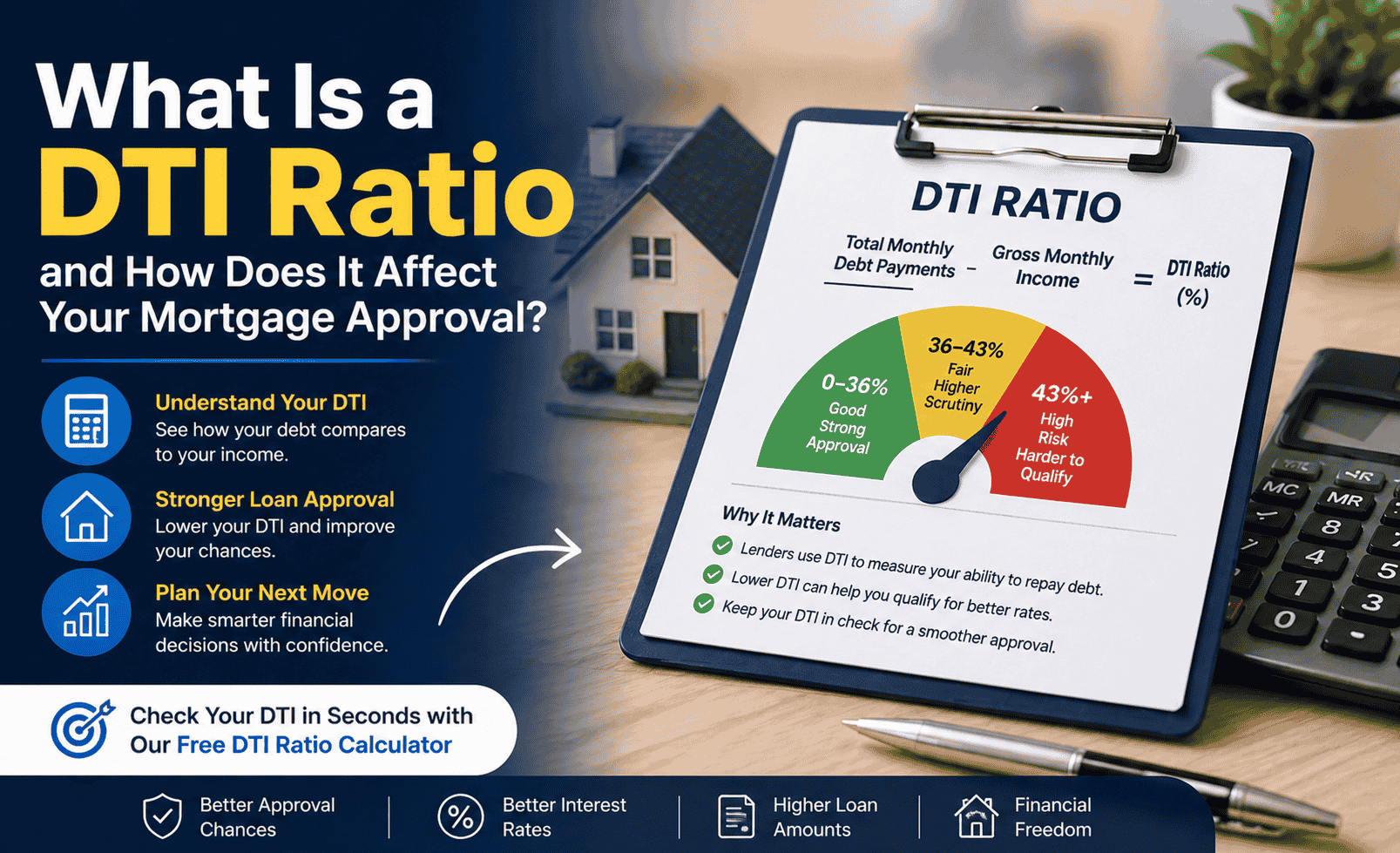
A debt-to-income ratio is a percentage that shows lenders how much of your gross monthly income is already committed to debt payments. The formula is straightforward: add up all your monthly debt obligations, divide by your gross (pre-tax) monthly income, and multiply by 100.
So if you earn $6,000 per month before taxes and your combined monthly debt payments total $2,100, your DTI ratio is 35%. That’s it. One number, calculated from two figures you almost certainly already know.
But here’s why that single number carries so much weight: a lender can’t know your spending habits, your lifestyle choices, or whether you’ll prioritise the mortgage when money gets tight. What they can see objectively is how much of your income is already spoken for. The lower that percentage, the more room you have to absorb a mortgage payment comfortably, and the lower the risk you represent to the lender.
DTI has been a standard part of mortgage underwriting for decades. Lenders learned, through cycles of defaults and economic stress, that borrowers with high debt-to-income ratios are significantly more likely to struggle with repayment when income drops or unexpected expenses arise. The thresholds you’ll read about throughout this article aren’t arbitrary. They reflect real data on default rates at different DTI levels.
How to Calculate Your DTI Ratio
The calculation itself is simple. What trips people up is knowing exactly what to include and what to leave out. Let’s walk through it step by step.
Step 1: Add up your gross monthly income
This is your income before any taxes or deductions. If you’re salaried, divide your annual salary by 12. If you’re paid hourly, multiply your hourly rate by average weekly hours, then multiply by 52 and divide by 12. If you have multiple income sources, a second job, rental income, freelance work, alimony received, include those too, as long as they’re consistent and documentable.
Step 2: Add up all your monthly debt payments
This is where most people undercount. You need to include every recurring debt payment: your proposed mortgage payment (principal and interest), property taxes, homeowner’s insurance, HOA fees if applicable, car loans, student loan minimums, credit card minimum payments, personal loans, and any child support or alimony you pay. We’ll cover exactly what counts and what doesn’t in detail later.
Step 3: Divide and multiply
Divide your total monthly debt by your gross monthly income, then multiply by 100 to get a percentage. That’s your DTI ratio.
Gross monthly income: $7,500
Monthly debts: Proposed mortgage $1,450 + car loan $380 + student loan $220 + credit card minimums $75 = $2,125 total
DTI calculation: $2,125 ÷ $7,500 × 100 = 28.3%
This borrower is comfortably within conventional loan limits and would likely qualify for competitive rates.
You can run this calculation manually, but it gets complicated quickly when you’re comparing different mortgage amounts, testing different scenarios, or trying to figure out how much mortgage you can afford without exceeding a target DTI.
Front-End vs Back-End DTI: What’s the Difference?
Most people hear “DTI ratio” and think there’s just one number. There are actually two, and lenders look at both, though they weigh them differently.
Front-end DTI (the housing ratio)
The front-end ratio looks only at your housing costs as a percentage of gross income. It includes your mortgage principal and interest, property taxes, homeowner’s insurance, and HOA fees if applicable. This combination is sometimes called PITI. The front-end ratio tells lenders how much of your income is consumed by housing alone.
For conventional loans, most lenders want the front-end ratio under 28%. FHA loans allow up to 31%. If your housing costs alone eat up more than a third of your gross income, that’s considered a warning sign regardless of what else is happening in your finances.
Back-end DTI (the total debt ratio)
The back-end ratio is what most people mean when they say “DTI.” It includes everything in the front-end ratio plus all other monthly debt obligations, car loans, student loans, credit card minimums, personal loans, and any child support or alimony payments. This is the number that carries the most weight in lending decisions.
In practice, lenders focus primarily on back-end DTI because it captures the complete picture of your obligations. However, a borrower with a high front-end ratio, meaning housing costs are a disproportionate share of their debt load, can still raise concerns even if back-end DTI is acceptable. Both numbers matter, and ideally both should be within guidelines.
| DTI Type | What It Includes | Conventional Limit | FHA Limit |
|---|---|---|---|
| Front-End | Mortgage P&I + property tax + insurance + HOA | 28% | 31% |
| Back-End | All housing costs + car loans + student loans + credit cards + all other debts | 43% | 50% |
DTI Ratio Ranges and What Each Level Means
Not all DTI ratios are created equal. Where your number falls on the spectrum directly affects your approval odds, the interest rate you’ll be offered, and which loan programs are available to you.
It’s worth noting that these ranges represent guidelines, not absolute rules. A borrower with a 44% DTI and a 780 credit score and 20% down payment may still get approved where someone with the same DTI but a 640 score and 5% down gets denied. DTI doesn’t work in isolation, but it is the starting point of the conversation.
DTI Limits by Loan Type
Different loan programs have different DTI thresholds, and knowing which program you’re targeting helps you understand exactly what number you need to hit.
| Loan Type | Front-End Limit | Back-End Limit | Notes |
|---|---|---|---|
| Conventional | 28% | 43-45% | Fannie Mae/Freddie Mac backed. Strong credit can push limits higher with DU approval. |
| FHA | 31% | 43-50% | More flexible. 50% back-end possible with compensating factors and AUS approval. |
| VA | No limit | 41% preferred | No official front-end requirement. Back-end above 41% needs residual income analysis. |
| USDA | 29% | 41% | Stricter limits. Rural properties only. Limited flexibility on exceptions. |
| Jumbo | 28% | 38-43% | Lender-specific. Generally stricter than conventional. Larger reserves often required. |
VA loans deserve a special mention because they’re the most nuanced. The VA doesn’t technically set a DTI limit. Instead, they use a residual income test, which looks at how much money you have left over after all debt payments and estimated living expenses. A borrower with a 50% DTI but strong residual income may still be approved for a VA loan. This is one reason VA loans are often the most accessible path for eligible buyers with higher debt loads.
Most mortgage applications today run through automated underwriting systems, Desktop Underwriter (Fannie Mae) or Loan Prospector (Freddie Mac). These systems sometimes approve loans with DTI ratios above the standard limits when other factors are strong, such as high credit scores, significant cash reserves, or large down payments. This is why the limits in the table above are guidelines rather than hard ceilings.
How DTI Affects Your Mortgage Approval
DTI affects your application at multiple points in the process, not just at initial approval.
Pre-qualification and pre-approval
When a lender gives you a pre-qualification or pre-approval letter, they’re telling you the maximum loan amount they’re willing to lend you based on your current financial profile. DTI is a primary driver of that number. If your DTI is high, the pre-approval letter will show a lower loan amount, or you may not receive one at all. This is why checking your DTI before you start house hunting matters so much. Walking into the process knowing your number avoids the disappointment of falling in love with a home you can’t actually qualify for.
Interest rate pricing
Even within the range of approvable DTIs, your ratio affects the rate you’re offered. Lenders price loans based on risk. A borrower with a 29% DTI and a borrower with a 42% DTI might both be approved for the same loan amount, but they won’t necessarily be offered the same rate. The higher-DTI borrower represents more repayment risk, and that risk gets priced into the interest rate. Over a 30-year loan, even a 0.25% difference in rate translates to tens of thousands of dollars.
Loan program eligibility
Your DTI determines which loan programs are available to you. If you’re at 46%, conventional is off the table and you’re looking at FHA. If you’re at 52%, even FHA becomes uncertain and you’re in territory where most lenders will decline outright. The loan program you qualify for affects everything, including minimum down payment requirements, mortgage insurance costs, and the total long-term cost of the loan.
Many first-time buyers calculate their DTI using their current debts, before adding the proposed mortgage payment. Then they’re surprised when the lender’s pre-approval number is lower than expected. Your DTI calculation must include the proposed mortgage payment (PITI), not just your existing debts. Always model your DTI with the new payment included.
What Counts in Your DTI and What Doesn’t
This is one of the most misunderstood aspects of DTI, and getting it wrong in either direction causes problems. Include too much and you’ll think your DTI is worse than it is. Include too little and you’ll be surprised at underwriting.
What counts (include these)
- Proposed mortgage payment — principal, interest, property taxes, homeowner’s insurance, and HOA fees (PITI). This is the full housing cost, not just the principal and interest portion.
- Car loans and auto leases. The full monthly payment, even if you’re near the end of the term.
- Student loans. The required monthly payment. If you’re in income-driven repayment, lenders may use either the actual payment or a percentage of the outstanding balance (rules vary by loan type).
- Credit card minimum payments. Not your typical payment, just the stated minimum on each statement.
- Personal loans and installment loans.
- Child support and alimony you pay.
- Any co-signed loans where you’re liable.
What doesn’t count (exclude these)
- Utilities: electricity, gas, water, internet, phone.
- Groceries and food expenses.
- Subscriptions: streaming services, gym memberships, software.
- Insurance premiums (health, car, life), except homeowner’s insurance which is part of PITI.
- Childcare costs, though some lenders consider these informally.
- Retirement contributions or savings.
- Note: credit cards you pay in full each month still count. Lenders use the minimum payment even if you clear the balance every month.
Student loans in deferment or forbearance are handled differently by different loan programs. FHA typically uses 1% of the outstanding balance as the monthly payment if the loan is deferred. Conventional loans (Fannie Mae) use either the actual payment or 1% of the balance, whichever is higher. VA loans use the actual documented payment or 5% of the balance divided by 12. If you have significant student debt, the loan type you choose can meaningfully affect your qualifying DTI.
How to Lower Your DTI Before Applying
If your DTI is higher than you need it to be, you have two levers: reduce your monthly debt obligations or increase your gross monthly income. Both are legitimate paths, and often the most effective approach combines elements of both.
- 1 Pay off small debts completely. Eliminating a debt payment entirely, even a small one, improves your DTI more than making extra payments on a large debt. A $200/month car payment that you eliminate drops your DTI by roughly 2-3 percentage points on an average income. Target debts you can clear fully in the next 3-6 months before applying.
- 2 Stop taking on new debt. This sounds obvious but many buyers finance furniture, appliances, or a new car in the months before applying for a mortgage. Any new debt payment added after you’ve checked your DTI will push the number higher at underwriting. A common rule: freeze all major spending from at least 90 days before applying.
- 3 Pay down credit card balances to reduce minimums. Credit card minimums are typically calculated as a percentage of your outstanding balance (often 1-2%). Reducing your balance reduces the minimum payment that counts toward your DTI. This also improves your credit score simultaneously, which helps on both fronts.
- 4 Increase your documented income. Gross income is the denominator in the DTI calculation. Increase it and DTI drops automatically. Side income, a raise, a second job, or rental income from a property you own can all count if they’re consistent and documentable. Lenders typically want 2 years of documented history for self-employment or side income to include it.
- 5 Apply for a smaller loan amount. If your DTI is borderline, reducing the loan amount you’re applying for lowers the proposed mortgage payment, which is part of your DTI calculation. Buying a less expensive home, increasing your down payment, or targeting a shorter price range can bring DTI within acceptable limits. Use the mortgage payment calculator to see how different loan amounts affect your payment.
- 6 Add a co-borrower with strong income. Adding a co-borrower increases the gross income figure in the DTI calculation, which lowers the ratio. Their debts also get added, so this only helps if their income gain outweighs their debt load. This is why a spouse or partner with high income but low debt can dramatically improve joint DTI compared to applying solo.
DTI vs Credit Score: Which Matters More?
This is one of the most common questions buyers ask, and the answer is that they serve different purposes in the underwriting process, and you really need both to be in good shape.
Your credit score tells lenders about your track record with debt: do you pay on time, how much of your available credit are you using, how long have you been managing credit responsibly? It’s a backward-looking measure of reliability.
Your DTI ratio tells lenders about your current capacity: right now, today, how much of your income is already committed? It’s a forward-looking measure of affordability.
| Factor | Credit Score | DTI Ratio |
|---|---|---|
| What it measures | Past repayment behaviour | Current income vs debt load |
| Primary question answered | Will this borrower pay? | Can this borrower pay? |
| Can it compensate for the other? | Partially. A high score can offset borderline DTI. | Less so. High DTI is harder to overcome with credit alone. |
| Hard cutoffs? | Yes, most programs have minimum scores. | Yes, most programs have maximum DTI limits. |
| Affects interest rate? | Yes, significantly. | Yes, to a lesser degree. |
In practice, credit score tends to have more influence on the interest rate you receive, while DTI has more influence on whether you get approved at all. A borrower with a 760 credit score and a 46% DTI may get approved, possibly with a rate adjustment. A borrower with a 620 credit score and a 28% DTI may also get approved, but will pay a meaningfully higher rate. The sweet spot is a credit score above 740 and a back-end DTI below 36%. That combination typically unlocks the best available rates across all loan programs.
Common DTI Mistakes Buyers Make
After walking through the mechanics, here are the real-world mistakes that cost buyers either their approval or a better rate:
Using net income instead of gross
DTI always uses gross monthly income, your pre-tax earnings. Using take-home pay makes your DTI look worse than it actually is and may cause you to unnecessarily delay your application or target a smaller loan than you actually qualify for.
Forgetting to include the full PITI
Many buyers calculate their DTI using just the principal and interest on the proposed mortgage. Property taxes, homeowner’s insurance, and HOA fees are also part of the housing cost that counts. In high-tax states or areas with significant HOA fees, these additions can push DTI materially higher than expected.
Opening new credit before closing
Getting approved for a mortgage is not the end of the process. Lenders often do a final credit pull right before closing. A new car loan, furniture financing, or even a new credit card opened after pre-approval can trigger a re-underwrite and potentially change your loan terms or kill the deal entirely. Keep your financial profile stable from application to closing.
Ignoring deferred student loans
Many buyers in income-driven repayment plans or deferment assume their student loans don’t affect their DTI because they’re not currently making payments. They do. Most lenders use either the actual payment or a percentage of the outstanding balance, even if the loan is deferred. This catches a lot of first-time buyers off guard.
Not checking DTI before house hunting
The single most common mistake is not running the numbers until late in the process. Knowing your DTI before you start looking tells you your realistic price range, which loan programs are available to you, and whether you need to take any corrective steps before applying. Spending months looking at homes in a price range you can’t actually qualify for wastes time and creates unnecessary frustration.
Calculate Your DTI Ratio Right Now
Enter your income and debt figures and get your front-end and back-end DTI instantly, plus loan program eligibility, a visual breakdown, and a personalised reduction plan.
Check My DTI Ratio →