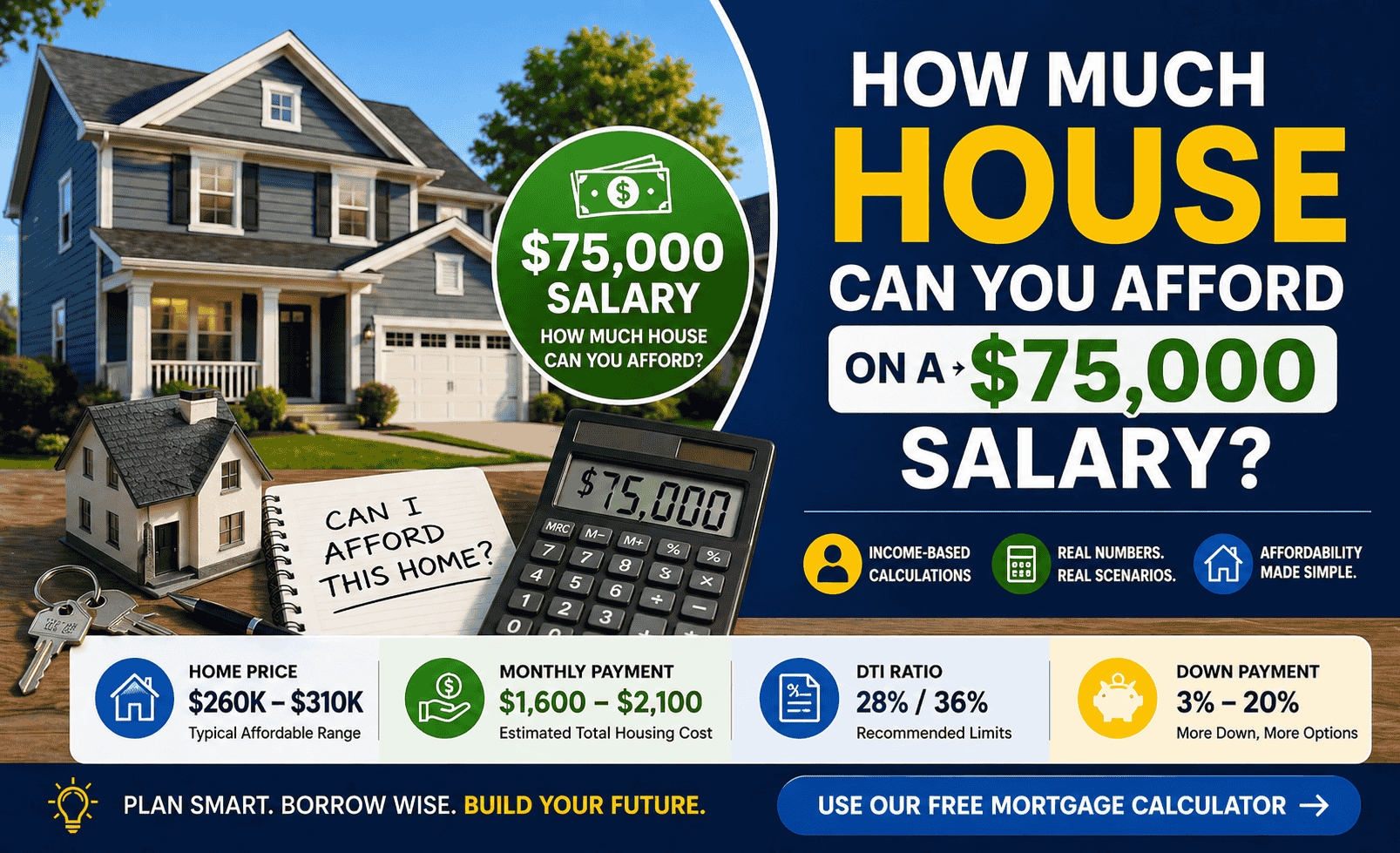
A $75,000 salary puts you close to the US household income median, which means millions of buyers are working with roughly the same budget, asking roughly the same question. The honest answer isn’t a single number. It’s a range that depends on how much debt you’re carrying, how much you’ve saved for a down payment, where you’re buying, and what interest rate you can get.
What I can give you is the actual math. Not a vague multiplier rule, but the real calculation lenders use, with real dollar amounts at $75,000 income, so you walk away knowing exactly what you can afford, what’s borderline, and what’s out of range at your current numbers.
This article covers the full picture: the calculation method, real scenarios across different debt loads and down payments, how location changes everything, and what you can do to increase your buying power before you apply.
The Quick Answer for $75,000 Income
At $75,000 annual income with no existing debt and a 10% down payment at current rates, most lenders will approve you for a home in the $260,000–$310,000 range. With 20% down and clean finances, that stretches toward $320,000–$350,000. With significant existing debt, car loans, student loans, credit card minimums, the range drops to $180,000–$230,000 or lower.
That’s a wide range, and the spread is intentional. Your debt load is the single biggest variable in the affordability calculation, more than your down payment, more than the interest rate. Before you even look at the price range, you need to know your monthly debt obligations.
How Lenders Actually Calculate What You Can Afford
Lenders don’t use income multipliers. They use debt-to-income ratios. Two numbers: the front-end DTI and the back-end DTI. Both are calculated from your gross monthly income, $6,250 at a $75,000 salary.
Front-end DTI (the housing ratio)
The front-end ratio measures your proposed housing costs, mortgage principal and interest, property taxes, homeowner’s insurance, and HOA fees if applicable, as a percentage of gross monthly income. At $75,000, the 28% front-end limit gives you a maximum housing budget of $1,750/month. That’s every housing cost combined, not just the mortgage payment.
Back-end DTI (the total debt ratio)
The back-end ratio adds all your other monthly debt obligations, including car loans, student loans, credit card minimums, and personal loans, to your housing costs. At $75,000, the 43% back-end limit means your total monthly debts (housing + everything else) cannot exceed $2,688. Whatever your existing debts consume, the remainder is what’s available for housing.
If you have $800/month in existing debt payments (a common amount for someone with a car loan and student loans), your back-end limit of $2,688 leaves only $1,888 for housing, which is actually higher than the $1,750 front-end limit. So your front-end limit is the binding constraint. But if you have $1,200/month in debts, the back-end leaves only $1,488 for housing, lower than the front-end limit. At that point, your debt load is the binding constraint. This is why debt matters more than almost anything else.
The 28/36 Rule Applied to $75,000
The 28/36 rule is the traditional mortgage affordability guideline. It says your housing costs shouldn’t exceed 28% of gross income, and total debts shouldn’t exceed 36%. At $75,000, here’s what those limits mean in real dollars:
| DTI Rule | Percentage | Monthly Limit at $75K | What It Covers |
|---|---|---|---|
| Front-end (housing) | 28% | $1,750/month | Mortgage P&I + property tax + insurance + HOA |
| Back-end conservative | 36% | $2,250/month | All housing costs + all other monthly debts |
| Back-end maximum | 43% | $2,688/month | Conventional loan maximum |
| Back-end FHA max | 50% | $3,125/month | FHA with compensating factors |
The difference between the 36% guideline and the 43% maximum is meaningful at this income level. The conservative 36% approach leaves $500 less per month available for housing if you have debts. Over the course of a mortgage, that difference can mean $50,000–$70,000 less in affordable home price. The 28/36 rule is a good target; 43% is the ceiling most lenders allow.
How Your Existing Debt Changes Everything
At $75,000 income, existing debt is the most powerful variable in your affordability calculation. Every $100 in monthly debt payments reduces your affordable home price by approximately $15,000–$18,000 at current rates. That’s not a rounding error, it’s the difference between a starter home and no home at all in many markets.
| Monthly Debt Payments | Housing Budget Left (43% DTI) | Estimated Home Price | Assessment |
|---|---|---|---|
| $0 (debt-free) | $1,750 (front-end limit) | ~$295,000–$315,000 | ✅ Strong position |
| $300/month | $1,750 (still front-end limited) | ~$285,000–$305,000 | ✅ Good position |
| $600/month | $2,088 back-end – $600 = $1,750 (still OK) | ~$265,000–$285,000 | ✅ Acceptable |
| $900/month | $2,688 – $900 = $1,788 (back-end limited) | ~$230,000–$255,000 | ⚠️ Tightening |
| $1,200/month | $2,688 – $1,200 = $1,488 | ~$190,000–$215,000 | ⚠️ Constrained |
| $1,500/month | $2,688 – $1,500 = $1,188 | ~$150,000–$175,000 | ❌ Very limited |
The $1,200/month debt scenario is more common than people realise. A car payment of $500, student loan minimum of $350, and credit card minimums of $350 adds up fast. That combination alone drops your affordable home price by roughly $80,000–$100,000 compared to the debt-free scenario. If you’re in this position, paying down debt before applying is worth far more than saving a larger down payment.
How Down Payment Affects Your Price Range
Your down payment affects affordability in two ways: it reduces the loan amount (which lowers your monthly payment), and it may eliminate the need for PMI (private mortgage insurance), which can add $100–$300/month to your costs on a moderate home price.
| Down Payment | Amount (on $280K home) | Loan Amount | Monthly P&I (6.5%) | PMI Required? |
|---|---|---|---|---|
| 3.5% (FHA minimum) | $9,800 | $270,200 | $1,708 | Yes, MIP for life of loan |
| 5% | $14,000 | $266,000 | $1,682 | Yes, until 20% equity |
| 10% | $28,000 | $252,000 | $1,593 | Yes, until 20% equity |
| 20% | $56,000 | $224,000 | $1,416 | No PMI ✅ |
The jump from 10% to 20% down eliminates PMI and saves approximately $177/month on the payment. Over 10 years that’s roughly $21,000, a meaningful number. But saving from $28,000 to $56,000 in down payment takes time, and during that time you’re paying rent. Whether it’s worth waiting depends on your local rent level and how fast home prices are moving in your market. Use the rent vs buy calculator to model the timing question for your specific situation.
Real Scenarios: Low Debt vs High Debt at $75K
Let’s run three real scenarios at exactly $75,000 income, 10% down payment, 6.5% mortgage rate, and typical property taxes/insurance for a mid-range US market.
Gross monthly income: $6,250
Existing debts: $200/month (one small car payment)
Back-end budget remaining: $2,688 – $200 = $2,488 for housing
Front-end limit: $1,750 (binding constraint)
Estimated home price: $285,000–$305,000
Assessment: Solid position. Options in most affordable and mid-tier markets.
Gross monthly income: $6,250
Existing debts: $700/month (car $420 + student loan $280)
Back-end budget remaining: $2,688 – $700 = $1,988 for housing
Front-end limit: $1,750 (still binding)
Estimated home price: $255,000–$275,000
Assessment: Workable in affordable markets. Tight in mid-tier cities. Very limited in expensive markets.
Gross monthly income: $6,250
Existing debts: $1,100/month (car $480 + student $380 + credit card minimums $240)
Back-end budget remaining: $2,688 – $1,100 = $1,588 for housing
Back-end is now the binding constraint at $1,588
Estimated home price: $195,000–$220,000
Assessment: Very limited. Only viable in the most affordable US markets. Debt reduction before applying is strongly advisable.
Where You Live Changes Your Price Range Dramatically
Your income is fixed. The home prices available at your budget are not fixed. They vary enormously by location. The same $280,000 budget buys a very different home depending on where you’re looking.
| Market | What $280K Buys | Median Home Price | $75K Buyer Assessment |
|---|---|---|---|
| Memphis, TN | 3–4 bed, decent neighborhood | ~$210,000 | ✅ Strong buyer |
| Columbus, OH | 2–3 bed, suburban starter | ~$290,000 | ✅ Competitive buyer |
| Phoenix, AZ | Small condo or distant suburb | ~$430,000 | ⚠️ Very limited options |
| Austin, TX | Very little, below median by $250K | ~$530,000 | ❌ Effectively priced out |
| San Francisco, CA | Nothing, median is 4× your budget | ~$1,200,000 | ❌ Not viable without dual income |
This table makes a point that raw income calculations miss: $75,000 is a solid buying income in most of the Midwest and South. It’s a struggling income in Texas’s major metros. And it’s effectively a renting income in California’s coastal cities. Location is a financial decision as much as a personal one.
Calculate Your Exact Affordable Price Range
Enter your income, debts, down payment, and local tax rate to get your maximum home price, monthly payment breakdown, front-end and back-end DTI, and loan program eligibility instantly.
Calculate My Affordable Price Range →Which Loan Programs Are Available at $75K?
Your income alone doesn’t determine loan program eligibility, your credit score, debt load, and down payment savings do. But at $75,000, here’s how the main programs stack up.
| Loan Program | Min Down Payment | Max Back-End DTI | Key Advantage at $75K |
|---|---|---|---|
| Conventional | 3–5% | 43–45% | No upfront MIP; PMI drops at 20% equity |
| FHA | 3.5% | 43–50% | More flexible on credit; higher DTI allowed |
| VA | 0% | 41% (residual income test) | No down payment, no PMI, best program if eligible |
| USDA | 0% | 41% | No down payment in eligible rural areas |
For a $75,000 income buyer with moderate debt, FHA is often the most accessible entry point because of its higher allowable DTI and lower down payment requirement. However, FHA loans carry a mortgage insurance premium for the life of the loan, which adds roughly $150–$200/month on a $250,000 loan. If your credit score is 700+ and you have 5% down, conventional often works out cheaper over time despite the stricter DTI. Check your DTI ratio against each program’s limits before deciding which to target.
How to Increase Your Buying Power Before Applying
If your current numbers don’t get you to the price range you need, there are specific actions that move the needle, some faster than others.
- 1 Pay off or pay down your highest monthly payment debts first. Remember: every $100 in monthly debt eliminated adds roughly $15,000–$18,000 to your affordable home price. A car loan with $450/month remaining could be worth eliminating before applying, that single move can add $67,000–$81,000 to your price range.
- 2 Reduce credit card balances to lower your minimum payments. Credit card minimums are calculated as a percentage of the outstanding balance. Cutting a $5,000 credit card balance to $1,000 can reduce your minimum payment by $80–$120/month, a meaningful DTI improvement that also boosts your credit score at the same time.
- 3 Add a co-borrower. A spouse or partner with income and manageable debt can significantly expand your buying power. Their income gets added to the gross income figure, which raises all your DTI limits. Even a modest second income of $30,000/year adds $2,500/month in gross income and approximately $175,000 in affordable home price at the same debt load.
- 4 Document any additional income streams. Side income, rental income, or consistent overtime can count toward your qualifying income if documented. Lenders typically want 2 years of tax returns showing the income. Even $5,000/year in documented side income ($417/month) adds roughly $50,000 to your affordable home price.
- 5 Improve your credit score before applying. A higher credit score unlocks better rates, which directly increases affordability. Moving from a 680 to a 740 score can lower your interest rate by 0.25–0.5%, which translates to roughly $10,000–$20,000 more in affordable home price on a $250,000 loan. Pay bills on time, reduce utilisation, and don’t apply for new credit in the 6 months before your mortgage application.
Mistakes $75K Buyers Make When Estimating Affordability
Using a simple income multiplier
You’ll often see rules like “you can afford 3× to 5× your annual income.” At $75,000, that would suggest $225,000–$375,000, a range so wide it’s almost useless. These multipliers don’t account for debt, local taxes, interest rates, or down payment. The DTI-based calculation this article walks through is what lenders actually use.
Forgetting property taxes and insurance
Many buyers calculate how much home they can afford based on the mortgage payment alone. But the housing budget of $1,750/month has to cover principal and interest and property taxes and homeowner’s insurance and HOA fees. In a high-tax state like New Jersey or Illinois, property taxes alone can consume $400–$700/month on a $280,000 home, leaving only $1,050–$1,350 for mortgage P&I, which significantly reduces the loan amount you can carry.
Not accounting for PMI
If you’re putting down less than 20%, PMI adds $100–$250/month to your housing costs on a typical loan in this price range. That has to come out of your $1,750 monthly housing budget, which reduces the loan amount you can afford by $15,000–$40,000 depending on the PMI rate.
Calculating affordability at maximum DTI
Just because a lender will approve you at 43% back-end DTI doesn’t mean that’s a comfortable number to live at. At $75,000 income, a 43% back-end DTI means $2,688/month in debt payments. After taxes, that might leave very little for savings, emergencies, childcare, or anything unexpected. Many financial advisors suggest targeting a back-end DTI of 36% or below, which is more conservative but also more financially stable.
Lenders approve you up to the maximum they’re willing to lend, not what’s optimal for your financial life. At $75,000 income, being approved for a $300,000 home doesn’t mean a $300,000 home fits your lifestyle, savings goals, and financial buffer needs. Many buyers at this income level find that targeting 10–15% below their maximum approval amount gives them significantly more financial breathing room, for emergencies, home repairs, retirement contributions, and just living without financial stress.
Find Your Exact Price Range at $75,000
Enter your income, monthly debts, down payment, and interest rate to see your maximum home price, full monthly payment breakdown, and which loan programs you qualify for.
Calculate My Home Budget – Free Tool →