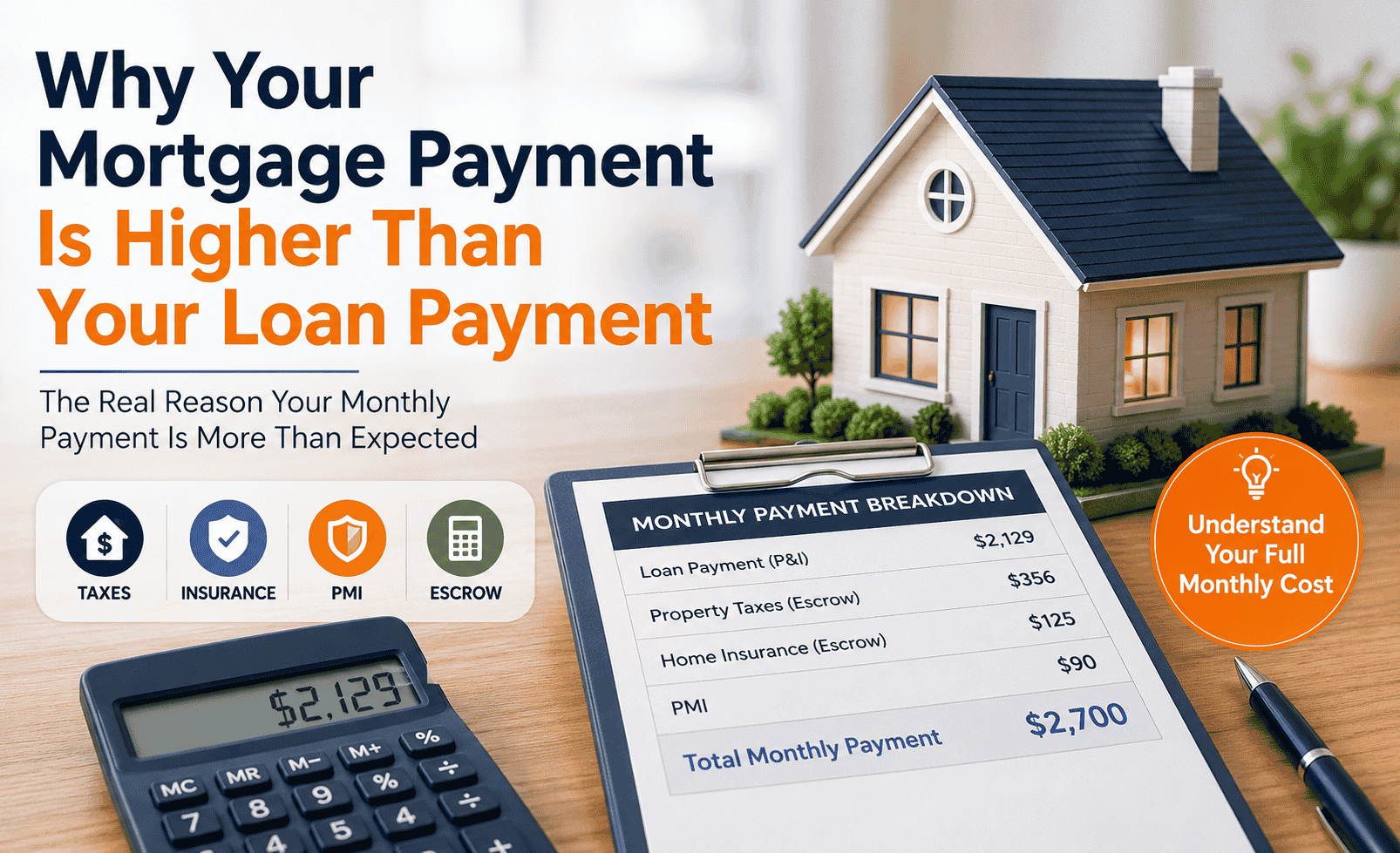
You ran the numbers on a mortgage calculator. It said $2,129 per month for a $320,000 home at 7% over 30 years. That felt manageable. Then you talked to a lender and they quoted something closer to $2,700. Nothing changed about the loan. Same price, same rate, same term. So where did the extra $571 come from?
This happens to almost every first-time buyer. The confusion is not the buyer’s fault. Most mortgage calculators online show only the principal and interest payment. That is the loan repayment portion. But your actual monthly obligation to the lender includes several other costs that get collected alongside that payment every single month. This article breaks down every component, shows you exactly what a real payment looks like, and explains which parts you can control and which you cannot.
Principal and Interest: The Loan Repayment Portion
This is the part online calculators show. Principal is the portion of your payment that goes toward paying down the loan balance. Interest is what the lender charges for lending you the money. Together they make up what is called the P&I payment.
On a $320,000 loan at 7% over 30 years, the P&I payment is $2,129 per month. That number does not change for the life of the loan if you have a fixed rate. What changes is the split between principal and interest. In the early years, most of each payment goes toward interest. In the later years, more goes toward principal. This is called amortization.
On that same $320,000 loan at 7%, your first payment of $2,129 breaks down as roughly $1,867 in interest and only $262 toward the actual balance. By year 15, that same payment splits closer to $1,432 in interest and $697 toward principal. By the final years, almost the entire payment reduces the balance. The total payment amount never changes but what it accomplishes shifts significantly over time.
The P&I payment is the only part of your monthly obligation that goes directly to the lender as loan repayment. Everything else that gets added to your monthly payment serves a different purpose entirely.
Property Taxes: The Biggest Surprise for Most Buyers
Property taxes are assessed by your local government, not your lender. But your lender almost always requires that you pay them through an escrow account. This means one-twelfth of your annual property tax bill gets added to your monthly mortgage payment. The lender holds that money in escrow and pays the tax bill on your behalf when it comes due.
This is where the gap between the calculator number and the real number gets wide fast. Property tax rates vary dramatically by state and county. On a $350,000 home, the annual property tax bill could be anywhere from $1,400 in Alabama to over $7,500 in New Jersey or Illinois. That translates to an extra $117 to $625 per month added to your payment — before insurance or anything else.
When you purchase a home, the county often reassesses the property at the sale price. If the previous owner had owned the home for years and benefited from assessment caps, your tax bill after purchase may be significantly higher than what the seller was paying. Always check the current assessed value and local tax rate, not just what the seller’s payment was.
Homeowners Insurance: Required by Every Lender
Your lender requires homeowners insurance because the home is the collateral for the loan. Before you close, you must have a policy in place, and the annual premium gets divided by 12 and added to your monthly escrow payment alongside property taxes.
A typical policy on a $350,000 home runs $1,200 to $2,400 per year depending on location, home age, and local risk factors. That adds $100 to $200 per month. In high-risk areas like coastal Florida, annual premiums can reach $4,000 to $6,000 or more, adding $333 to $500 per month on top of everything else.
Standard homeowners insurance does not cover flood damage. If your home is in a FEMA-designated flood zone, your lender will require a separate flood insurance policy. FEMA’s National Flood Insurance Program (NFIP) policies average around $700 to $900 per year nationally, but properties in high-risk zones can pay significantly more. This is another cost that does not show up in a basic mortgage calculator and catches many buyers by surprise after the offer is accepted.
PMI: What It Is and When It Goes Away
PMI stands for private mortgage insurance. It protects the lender, not you, in the event you stop making payments. It is required on conventional loans when your down payment is less than 20% of the purchase price. The lender considers a lower down payment higher risk, and PMI is the cost of that risk.
PMI typically costs between 0.5% and 1.5% of the original loan amount per year, divided into monthly installments added to your payment. On a $300,000 loan at a 1% PMI rate, that is $3,000 per year or $250 per month. On top of principal, interest, taxes, and insurance, PMI can push a payment well past what most online calculators show.
Under federal law (the Homeowners Protection Act), your lender must automatically cancel PMI when your loan balance reaches 78% of the original purchase price based on your scheduled payments. You can also request cancellation when you believe your balance has reached 80% of the original value, either through payments or appreciation. You will typically need to request this in writing and may need a new appraisal. PMI does not disappear on its own the moment you hit 20% equity — you have to ask for it.
FHA loans charge an upfront premium of 1.75% of the loan amount (usually rolled into the loan) plus an annual premium added to monthly payments. On most FHA loans with less than 10% down, the annual MIP stays for the life of the loan — it does not cancel when you reach 20% equity. This is why buyers with improving credit often refinance out of an FHA loan into a conventional one once they have enough equity to drop the insurance entirely.
HOA Fees: Still Part of Your Monthly Housing Cost
If the property you buy is in a homeowners association, you will owe monthly or quarterly HOA dues. These are not part of your mortgage payment and do not go through escrow. They are billed separately by the HOA. But they absolutely affect how much you spend every month on housing, and lenders factor them into your DTI calculation when evaluating your application.
HOA fees range from under $100 per month for a basic single-family neighborhood association to $500 to $1,000 or more per month for condos or communities with extensive amenities like pools, gyms, security, and landscaping. High-rise condos in cities can run $1,500 or more per month. These fees are not optional and they can increase over time as the association’s expenses grow.
HOA fees typically cover shared amenities, exterior maintenance, landscaping, and reserves for future repairs to common areas. Some also cover water, trash, or building insurance for condo units. Before buying in an HOA community, request the association’s financial statements and reserve fund study. An underfunded HOA can hit owners with large special assessments when unexpected repairs come up, on top of regular monthly dues.
What a Real Monthly Payment Looks Like
A comment that shows up regularly in first-time buyer communities goes something like this: “We thought our payment would be around $2,200 based on what the calculator showed. After talking to our lender it came out closer to $3,100. We had no idea taxes and insurance added that much.” That gap is not unusual. It is what happens when a buyer plans around P&I only.
Here is an example that puts all of the components together. The scenario is a $380,000 home in Texas, 10% down, 30-year fixed at 7%, conventional loan, first-time buyer with a credit score in the 720 to 759 range.
A basic calculator showing only the P&I payment would say $2,275 per month. The real number is $3,174. That is a $899 difference every single month. Over a year that is $10,788 that a buyer who only looked at the P&I number was not planning for.
Move that same $380,000 purchase to South Carolina where the effective property tax rate on a primary residence runs closer to 0.57%, and the tax portion of the monthly payment drops from $507 to about $180. Total payment falls to roughly $2,848. Same home price, same loan, same rate, same insurance estimate. Just a different state. That $326 monthly difference over 30 years is nearly $117,000. Location matters more than most buyers realize when calculating the real cost of a home.
Why the Same Home Price Costs Different Amounts in Different States
Property taxes are the main driver of payment variation across states but they are not the only one. Insurance costs also vary significantly based on local risk. And in some states, certain fees and assessments are common that buyers from other regions would never expect.
Hawaii (lowest): Combined taxes and insurance add roughly $227 per month to your payment. New Jersey (highest): The same two items add $836 per month. That is a $609 monthly difference on identical loan terms, purely because of location. The cards below show where eight common states fall between those two extremes.
This table shows only taxes and insurance. Add P&I plus PMI if applicable and the full payment picture becomes clear. Two buyers purchasing a $380,000 home with the same loan terms can end up with monthly payments more than $600 apart simply because of where the home is located.
What You Can Control and What You Cannot
Understanding which parts of your payment are fixed and which are flexible helps you make smarter decisions before you buy.
Putting 20% down eliminates PMI entirely. Even going from 5% to 10% down reduces the PMI rate because the loan-to-value ratio improves. If PMI is adding $200 or more per month, the math on saving a larger down payment is worth running carefully.
A 15-year loan has a higher monthly P&I payment than a 30-year loan but you pay far less total interest and build equity much faster. A 20-year term sits in between. The term is a choice you make at closing and it directly affects what you pay every month.
Rates vary between lenders for the same borrower profile. A 0.25% difference on a $350,000 loan is about $59 per month, which is over $21,000 over 30 years. Getting quotes from multiple lenders before committing is one of the few ways to directly reduce the P&I portion of your payment.
Homeowners insurance is required but the provider is your choice. Getting three or four quotes before closing is standard practice and can save $200 to $600 per year on premium costs. Bundling with your auto insurance often provides a discount as well.
You cannot negotiate property taxes. The rate is set by your county and state. You can appeal an assessment if you believe the county has overvalued the property, and some states offer exemptions for primary residences or seniors, but the base rate is not negotiable.
HOA dues are set by the association and are not negotiable at the individual level. You can choose not to buy in an HOA community, which is the most effective way to avoid this cost. Once you are in, the fees are obligatory and can increase over time with a vote of the board.
What This Means for How Much House You Can Afford
Lenders qualify you based on your total monthly payment, not just the P&I. The debt-to-income ratio calculation that determines whether you get approved uses the full PITI figure, principal, interest, taxes, and insurance, plus HOA if applicable, plus all your existing monthly debt obligations.
This means a buyer with a $90,000 income who can technically afford a $2,800 P&I payment may find that the real payment on the home they want, once taxes and insurance are added, pushes their DTI above what the lender will approve. The calculator said one number. The lender approved a different one. The gap is almost always taxes and insurance.
Before you start making offers, run your numbers through a calculator that includes all components: principal, interest, property tax rate for the specific county you are looking in, estimated insurance, and PMI if your down payment is under 20%. The mortgage payment calculator lets you enter all of these so the number you see is the number you will actually pay, not just the loan repayment portion. If you want to know the maximum price you can realistically afford given your income and debts, the affordability calculator works backward from your budget to give you a realistic price ceiling.
A buyer who budgets based on P&I alone and then discovers the real payment is $700 higher has a problem at closing. They either have to buy less house than they planned, come up with more for the down payment to eliminate PMI, or choose a lower-tax location. All of those decisions are easier to make before you fall in love with a specific property.
See Your Real Monthly Payment Before You Start Shopping
Enter your target home price, down payment, state, and loan details. The calculator includes property taxes, insurance, and PMI so the number reflects what you will actually owe every month.
Calculate Your Full PaymentThe number a calculator shows and the number you actually pay are almost never the same. The difference is not hidden — it is just not shown. Now you know where to look.