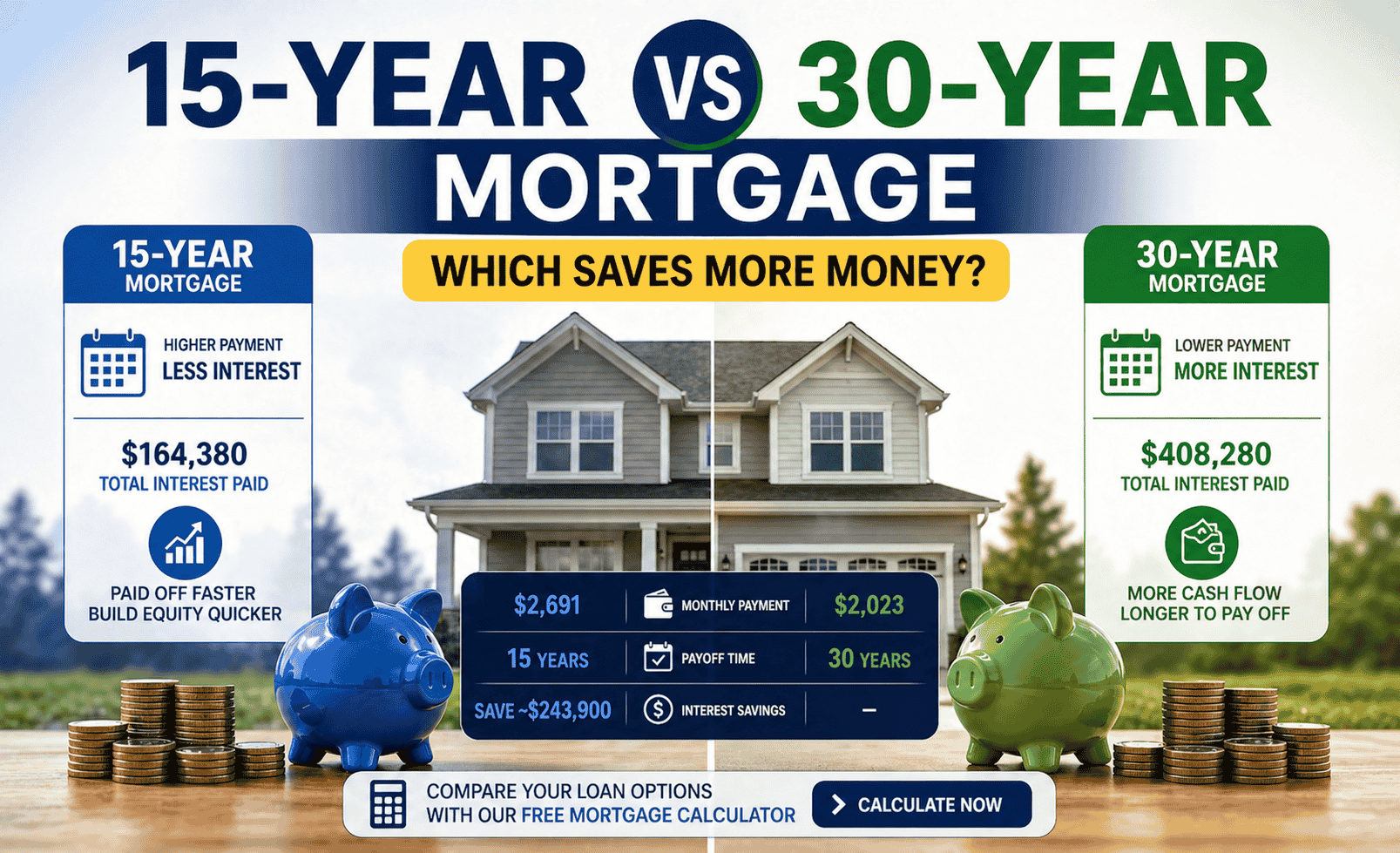
If you’re getting a mortgage, the 15-year vs 30-year decision will likely be one of the most financially significant choices you make. Choose the 30-year and your monthly payment is lower, but you’ll pay interest for twice as long. Choose the 15-year and you’ll save a staggering amount in interest, but your monthly payment will be noticeably higher every single month for the next decade and a half.
Neither option is universally better. The right answer depends on your income, your other financial goals, how long you plan to stay in the home, and how you think about cash flow versus long-term cost. What I can do is show you exactly what the numbers look like, not in theory, but in real dollar terms, so you can make this decision with clarity rather than guesswork.
This article walks through every dimension of the comparison: total interest paid, monthly payment difference, the investment argument, the equity build-up difference, and the specific situations where each loan term makes more sense.
The Core Tradeoff: Lower Payment vs Less Interest
The fundamental tension between a 15-year and 30-year mortgage comes down to one question: do you want to optimise for monthly cash flow or total lifetime cost?
A 30-year mortgage spreads your loan repayment over 360 months. Each payment is smaller because you have more time to repay. A 15-year mortgage compresses that into 180 months. Each payment is larger because you’re covering the same principal in half the time, but you also pay interest for far fewer months, which is where the massive savings come from.
On a typical US mortgage at current rates, the monthly payment difference between a 15-year and 30-year is roughly 30–40% higher for the 15-year. The total interest savings over the full loan life are typically in the range of $100,000 to $200,000 on a $400,000 loan, a number most borrowers don’t fully process when they’re focused on the monthly payment.
Real Numbers: What the Difference Actually Looks Like
Let’s ground this in a specific example. A $400,000 home with 20% down gives us a $320,000 loan. Using current national average rates approximately 6.5% for a 30-year and 5.9% for a 15-year, here’s what both options produce.
The monthly difference is $668. The total interest difference is $243,900. Read that second number again, a quarter of a million dollars in interest on the same loan amount, just from the loan term choice. That’s not a rounding error. That’s the real cost of 15 extra years of interest at 6.5%.
But before you conclude the 15-year is obviously better, the $668/month difference is also real. That’s $8,016 per year. Over 15 years that’s $120,240 in additional payments, money you could have invested, kept as an emergency buffer, or used to pay down other debt. The question is whether paying that extra amount to eliminate the mortgage faster is the best use of that money.
How Much Interest Does a 15-Year Mortgage Save?
The interest savings from a 15-year mortgage come from two sources that work together: a lower interest rate and a shorter repayment period. Both matter, and removing either one would significantly reduce the savings.
Source 1: Lower interest rate
Lenders typically offer 15-year mortgages at 0.5% to 1% lower than 30-year rates. This is because shorter-term loans are less risky for lenders, they get their money back faster and have less exposure to interest rate changes. On a $320,000 loan, a 0.6% rate difference saves roughly $27,000 in interest over the full loan life, just from the rate, before even factoring in the shorter term.
Source 2: Fewer months of interest
This is the bigger driver. With a 30-year mortgage, you’re paying interest on a large balance for 360 months. In the early years especially, the vast majority of each payment is interest. In year one of a 30-year mortgage at 6.5%, roughly 84% of your payment goes to interest. A 15-year mortgage at 5.9% starts at around 70% interest still high, but it pays down principal much faster, which means you stop paying interest on that principal sooner.
30-year mortgage ($320K at 6.5%): Year 1 payments total $24,276. Of that, approximately $20,610 goes to interest and only $3,666 reduces your principal balance.
15-year mortgage ($320K at 5.9%): Year 1 payments total $32,292. Of that, approximately $18,697 goes to interest and $13,595 reduces your principal balance.
The 15-year pays down nearly 4× as much principal in the same year, which means the interest-earning balance shrinks much faster, compounding the savings over time.
Equity Build-Up: Which Loan Pays Down Faster?
Equity is the portion of your home you actually own, and it builds differently depending on your loan term. This matters for several reasons: it affects how much you can borrow against your home (a HELOC, for instance), what happens if you need to sell, and how quickly you reach the point where you own your home outright.
| Year | 15-Year Balance | 30-Year Balance | Equity Difference |
|---|---|---|---|
| Start | $320,000 | $320,000 | $0 |
| Year 5 | $249,800 | $299,100 | $49,300 more equity |
| Year 10 | $163,200 | $271,400 | $108,200 more equity |
| Year 15 | $0 (paid off) | $234,400 | $234,400 more equity |
| Year 20 | Paid off | $184,700 | Full home owned for 5 years |
At year 10, the midpoint of a 15-year loan, the borrower has $108,200 more equity than their 30-year counterpart. That’s a meaningful difference if life throws a curveball: job loss, divorce, medical emergency, or a need to relocate. More equity means more options.
The Investment Argument for the 30-Year
Here’s the most compelling counterargument to the 15-year mortgage: the $668/month difference could be invested rather than paid to the bank, and over 15 years at reasonable market returns, that invested money might grow to more than the interest you’d save.
Monthly difference: $668
If invested for 15 years at 7% annual return: approximately $215,000
Interest saved by choosing 15-year: approximately $244,000
Verdict: In this scenario, the 15-year still wins financially, but only by about $29,000. At a higher assumed return (9–10%), the investment argument becomes more competitive. At lower returns or with market volatility, the 15-year wins more decisively.
The investment argument for the 30-year has two real weaknesses. First, it assumes consistent investment discipline for 15 years, the $668 difference actually gets invested every month without fail. In practice, most people don’t do this. The money gets absorbed into lifestyle spending. Second, the mortgage interest savings are guaranteed. The investment return is not.
That said, the argument genuinely applies if you have high-interest debt (credit cards, personal loans) that you’d pay off with the freed cash flow, or if you’re contributing to a 401(k) with employer matching that you’d otherwise miss out on. In those specific cases, the 30-year can produce a better financial outcome.
The math can work in favour of the 30-year IF you actually invest the difference consistently AND get reasonable market returns AND have the psychological discipline to hold through market downturns. For most people, most of the time, those three conditions aren’t all met. The 15-year is the simpler, lower-risk path to building wealth through homeownership. The 30-year investment strategy is theoretically sound but practically difficult to execute.
The Interest Rate Difference Between 15 and 30 Year
The rate discount on a 15-year mortgage is one of the most underappreciated aspects of this comparison. It’s not just a smaller number, it has a compounding effect on your savings over the life of the loan.
| Loan Term | Typical Rate (Apr 2026) | Monthly Payment ($320K) | Total Interest |
|---|---|---|---|
| 15-Year | 5.90% | $2,691 | $164,380 |
| 20-Year | 6.20% | $2,342 | $242,080 |
| 30-Year | 6.50% | $2,023 | $408,280 |
The 20-year option is worth noting as a middle ground, it doesn’t get discussed as often as 15 and 30-year loans, but it offers a meaningful compromise. The payment is lower than a 15-year but the total interest is significantly less than a 30-year. If the 15-year payment feels too tight but you want to pay less than a full 30-year in interest, ask your lender about 20-year terms.
Compare 15 vs 30 Year Side by Side
Enter your home price once and the mortgage calculator shows both loan terms simultaneously, including monthly payment, total interest, equity at each year, and payoff date.
Run My 15 vs 30 Year Comparison →Who Should Choose Each Loan Term?
The right answer isn’t about which loan is objectively better, it’s about which fits your specific financial situation. Here’s a framework for thinking through it clearly.
Choose the 15-year mortgage if:
- Your income is stable and high enough that the larger payment doesn’t create financial stress. A good rule of thumb: the 15-year payment should be no more than 28% of your gross monthly income.
- You plan to stay in the home long-term. The savings only fully materialise if you hold the loan to term. If you’re likely to sell or refinance within 7–10 years, the savings are reduced.
- You have no high-interest debt. If you’re carrying credit card or personal loan debt at 15–25%, paying that off first will save more money than the 15-year mortgage rate advantage.
- You’re close to retirement and want to enter retirement mortgage-free. Being debt-free at retirement has both financial and psychological value that pure interest math doesn’t fully capture.
- You have a fully-funded emergency fund and don’t need the lower payment as a cash flow buffer.
Choose the 30-year mortgage if:
- Your income is variable (self-employed, commission-based, seasonal). The lower required payment gives you flexibility in lean months. You can always pay more when income is strong.
- You have other high-return uses for the cash flow difference maxing out a 401(k) with employer matching, paying off high-interest debt, or building an emergency fund you currently lack.
- You’re early in your career and expect income to grow significantly. Locking into a high fixed payment when your income is lower creates unnecessary stress.
- You’re in a high cost-of-living area where the 15-year payment would consume too much of your income to maintain basic financial stability.
- You plan to move within 10 years. If you’re not keeping the loan to term, the 30-year’s flexibility often makes more sense.
The Middle Ground: 30-Year With Extra Payments
There’s a third option that many borrowers overlook entirely: take the 30-year loan for its flexibility, but make extra principal payments every month to replicate the payoff timeline and savings of a 15-year.
This approach gives you the best of both worlds in theory, the low required payment as a safety net, with the debt payoff speed and interest savings of a 15-year if you stay disciplined.
30-year loan: $320,000 at 6.5%, payment $2,023/month
To pay off in 15 years: add approximately $630/month extra to principal
Total payment with extra: approximately $2,653/month, similar to the 15-year payment
Interest saved vs standard 30-year: approximately $185,000
Catch: You’re still paying the higher 30-year rate (6.5% vs 5.9%), so you won’t save quite as much as a true 15-year. The 15-year still wins by roughly $58,000 in total interest if you’re truly committed to the payoff timeline.
The extra payment strategy works best for people who want the psychological safety of a lower minimum payment, knowing that if income drops, they can fall back to the base payment without defaulting. The key discipline is treating the extra payment as non-negotiable rather than optional.
Which Loan Term Makes Sense at Different Income Levels?
One of the most practical ways to think about this decision is to ask: what does each payment represent as a percentage of my income? The standard guideline is that total housing costs shouldn’t exceed 28% of gross monthly income.
| Annual Income | Gross Monthly | 28% Housing Budget | 15-Year Fits? ($2,691) | 30-Year Fits? ($2,023) |
|---|---|---|---|---|
| $80,000 | $6,667 | $1,867 | ❌ Too high | ⚠️ Tight |
| $100,000 | $8,333 | $2,333 | ⚠️ Tight | ✅ Comfortable |
| $120,000 | $10,000 | $2,800 | ✅ Fits | ✅ Comfortable |
| $150,000 | $12,500 | $3,500 | ✅ Comfortable | ✅ Very comfortable |
For a $400,000 home with 20% down at current rates, the 15-year mortgage realistically requires a household income of at least $115,000–$120,000 to stay within the 28% guideline. Below that threshold, the 30-year is the more financially stable choice, not because the 15-year is bad, but because stretching too thin on housing payments creates risk in every other area of your financial life.
Common Mistakes When Choosing a Loan Term
Choosing based on payment alone
Many buyers choose the 30-year simply because the payment is lower without ever calculating the total interest cost. If you saw “$244,000 in extra interest” on the page before the monthly payment, you might weigh the decision differently. Always look at total cost alongside monthly cost.
Overestimating what you’ll invest
The investment argument for the 30-year requires genuine discipline. If there’s any doubt about whether the cash flow difference will actually be invested, rather than spent, the 15-year is the more reliable path to long-term wealth.
Not accounting for taxes and insurance in the payment comparison
The $668 monthly difference is just principal and interest. Your actual total payment includes property taxes, homeowner’s insurance, and possibly PMI and HOA fees. These costs are the same regardless of loan term, so the true monthly difference between the two options as a percentage of your total housing cost is smaller than the P&I comparison suggests. Check your DTI ratio using the full payment, not just P&I.
Choosing the 15-year when cash reserves are thin
The 15-year mortgage is a higher fixed obligation. If an income disruption hits and you have no cash reserves, the higher required payment becomes a liability. Financial planners typically recommend having 6 months of expenses in reserve before committing to the higher 15-year payment.
Not considering a refinance strategy
Some buyers start with a 30-year loan and refinance to a 15-year when their income grows and they’re ready for the higher payment. This can be a smart approach, it avoids the income risk of the 15-year in the early years while still allowing you to capture the savings later. Use the mortgage refinance calculator to model what this looks like at different future income levels.
See Exactly What Each Option Costs for Your Home
Enter your home price, down payment, and interest rates to see how the mortgage calculator runs both loan terms side by side so you can see the monthly difference, total interest, and full amortization for each.
Compare 15 vs 30 Year Free Calculator →