Mortgage brokers use the words “qualify” and “pre-qualify” regularly, and often interchangeably. In everyday conversation that causes no confusion. But when those words are applied to tools, website workflows, and the processes a broker builds into their site, the distinction matters. A tool that pre-qualifies a borrower is doing something materially different from a tool that helps a broker qualify or assess their leads before the application, and treating them as the same thing creates problems: for how brokers describe their services, for how their website tools are framed, and for how visitors understand what they are being asked to do.
This article explains the difference between mortgage pre-qualification and mortgage lead qualification, why the distinction matters in practice, and how brokers can frame educational assessment tools on their sites in a way that is accurate and appropriate.
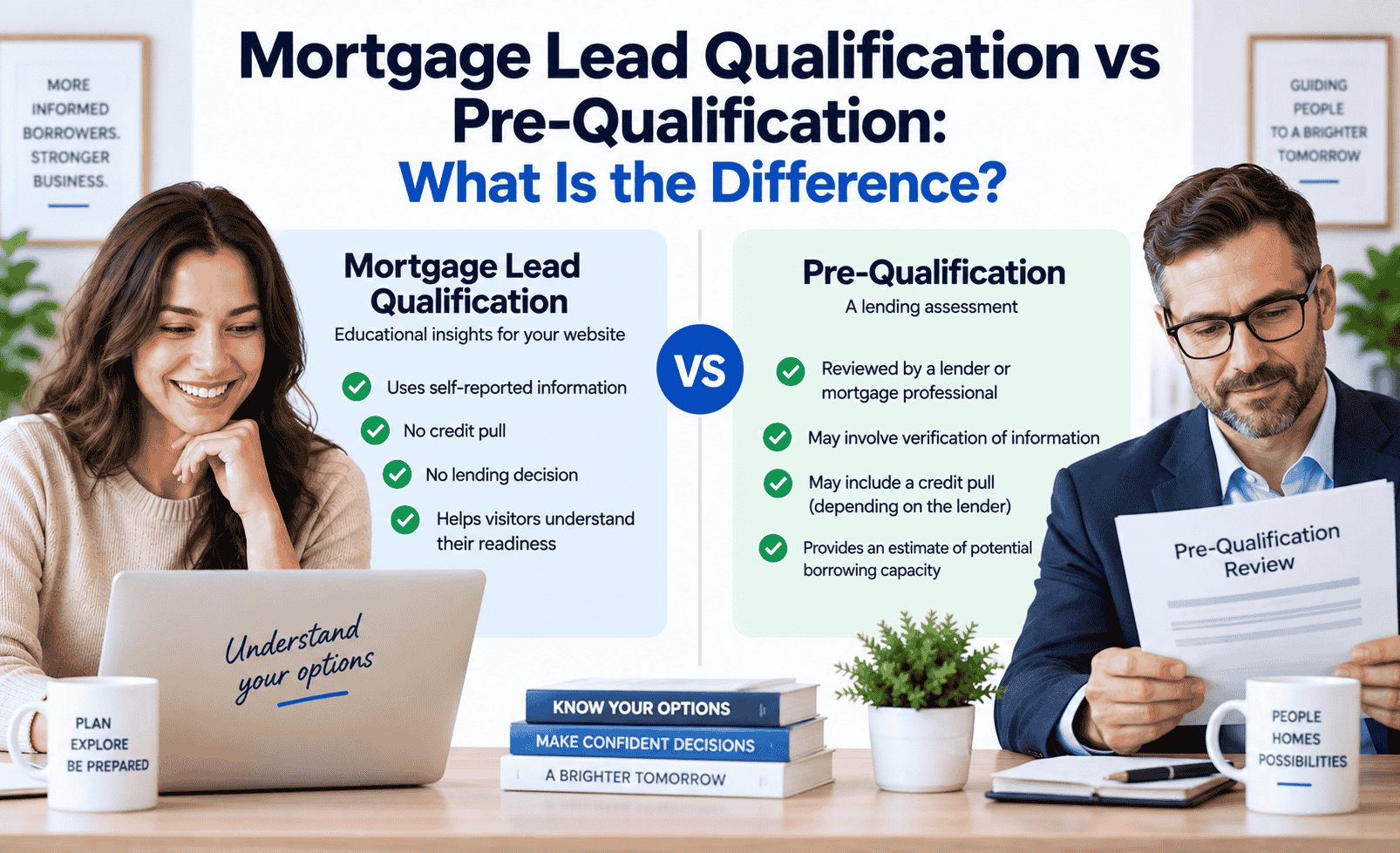
Mortgage pre-qualification is a lender or broker assessment of a borrower’s potential borrowing capacity, typically involving verification of income, assets, debts, and sometimes credit. Mortgage lead qualification, as used in this article, refers to an educational step a broker adds to their website that helps visitors understand their own financial readiness before deciding whether to begin a formal application. These are different activities with different purposes, different outputs, and different regulatory contexts.
Why the Distinction Matters for Brokers
The terminology confusion between pre-qualification and lead qualification is not purely academic. It has practical consequences for how a broker describes their website tools, how those tools are labeled for visitors, and how regulatory requirements may apply to the activity the tool performs.
A broker who describes an educational readiness assessment on their site as a “pre-qualification tool” is implying that the tool performs a lending function: that it evaluates a borrower’s creditworthiness and produces a determination of borrowing capacity. If the tool does not actually do that, the description is inaccurate. If it does, different regulatory considerations may apply depending on the broker’s license type, the loan programs involved, and the jurisdiction.
A broker who uses the correct framing, describing the tool as an educational readiness assessment that helps visitors understand their own financial picture before deciding whether to apply, is more accurate and helps clearly distinguish the tool’s educational purpose from a lending assessment.
The distinction also matters for the visitor. A borrower who believes they have been pre-qualified has a different expectation about what happens next than one who has completed an educational readiness check. Misaligned expectations create friction at exactly the point where the broker wants to build trust.
What Mortgage Pre-Qualification Is
Mortgage pre-qualification generally refers to a lender or broker assessment of a borrower’s potential borrowing capacity. The specific process and information used can vary significantly by lender, loan program, and workflow. In many implementations, pre-qualification involves the borrower providing income, asset, and debt information to the lender, who uses it to produce an estimate of how much the borrower may be able to borrow under a particular loan program.
Pre-qualification is typically distinguished from pre-approval by the level of verification involved. Pre-qualification often relies on self-reported information without formal verification of income or assets, and may or may not involve a credit inquiry. Pre-approval generally involves greater verification, often including documentation and a credit pull, and provides a more formal indication of borrowing capacity. Pre-approval typically carries more weight with sellers and real estate agents as evidence of a borrower’s financial position.
The important characteristic of pre-qualification, for the purpose of this article, is that it represents a lending assessment rather than an educational readiness check. It is generally conducted within a lender or broker’s mortgage workflow and evaluates the borrower’s financial situation in relation to specific loan programs and guidelines. The resulting assessment represents the lender’s or broker’s view of the borrower’s potential borrowing capacity and therefore carries professional weight that an educational readiness assessment does not.
Pre-qualification and pre-approval are sometimes used interchangeably in the industry, but they generally describe different levels of lender commitment. Pre-qualification is typically based on self-reported information with limited or no verification. Pre-approval typically involves verified documentation, a credit pull, and provides a more formal indication of borrowing capacity. Neither is a guarantee of final loan approval, which depends on full underwriting of the complete application and the specific property.
What Mortgage Lead Qualification Is
Mortgage lead qualification, as used in the context of broker websites and conversion funnels, refers to a different activity entirely. It is an educational step that a broker adds to their website to help visitors assess their own financial readiness before deciding whether to begin a formal mortgage application.
The purpose of a lead qualification step is not to produce a lending determination. It is to give the visitor a directional picture of where they stand based on factors they can self-report: their estimated target home price, their household income, their existing monthly debts, their approximate credit score range, and their available down payment. Using those inputs, the tool can calculate an estimated monthly payment and a debt-to-income ratio, and give the visitor a sense of whether their numbers appear to be in a range that typically supports a mortgage application or whether there are factors worth discussing with the broker first.
This is an educational activity, not a lending one. The tool does not verify the visitor’s information, does not pull their credit, does not consult loan program guidelines to produce a borrowing capacity estimate, and does not represent the professional view of a licensed mortgage broker on the visitor’s eligibility. It uses self-reported information to produce a directional, informational output that the visitor can use to make a more informed decision about whether to proceed to the application.
An educational lead qualification step on a broker website is not a pre-qualification, not a pre-approval, not a lending determination, and not a guarantee or indication of eligibility for any loan program. Any tool used in this way should be clearly labeled as an educational assessment and should carry an appropriate disclaimer making clear that the output is informational and not a lending decision. Brokers should confirm the appropriate labeling and disclaimers with compliance or legal counsel.
The Key Differences Side by Side
The table below summarizes the key distinctions between mortgage pre-qualification and an educational mortgage lead qualification step. These are general characterizations. The specific details of any pre-qualification process will vary by lender, loan program, and jurisdiction.
| Factor | Mortgage Pre-Qualification | Educational Lead Qualification |
|---|---|---|
| Who conducts it | A lender or mortgage professional, depending on the workflow | An automated tool on the broker site, using self-reported visitor inputs |
| Information used | Borrower-provided income, assets, debts; may include credit inquiry | Self-reported inputs: estimated price, income, debts, credit range, down payment |
| Verification | Varies: some lenders verify income and assets; others rely on self-reported data | None: all inputs are self-reported and unverified |
| Output | An estimate of borrowing capacity under specific loan programs | A directional readiness picture: estimated payment, estimated DTI, readiness signal |
| Nature of output | A professional lending assessment, even when clearly labeled as an estimate | An educational calculation with no professional lending determination |
| Credit pull | May involve a soft or hard credit inquiry depending on the lender | No credit pull of any kind |
| Regulatory context | Conducted by a licensed professional; various regulations may apply | Educational tool; brokers should review applicable requirements with counsel |
| Visitor expectation set | Borrower may expect a formal indication of borrowing capacity | Visitor receives educational context to help them decide whether to apply |
Why Confusing the Two Creates Problems
When a broker labels an educational readiness assessment on their site as a “pre-qualification tool” or describes the output as a “pre-qualification,” several problems can follow.
A visitor who believes they have been pre-qualified expects a formal indication of borrowing capacity, possibly one they can show to a real estate agent. When the tool produces a readiness score or a directional picture instead, the visitor’s expectation and the tool’s output do not align. That misalignment erodes trust at exactly the point where the broker wants to build it.
Describing an educational tool as a pre-qualification implies that the broker is conducting a lending assessment through that tool. If the tool uses self-reported inputs and produces a directional educational output, that description is inaccurate. Accurate framing, describing the tool as an educational readiness assessment, avoids this problem and gives the visitor an accurate picture of what they are receiving.
Mortgage lending activities, including pre-qualification, are subject to federal and state regulation. An educational assessment tool that is clearly labeled as informational, makes no lending determination, pulls no credit, and is accompanied by an appropriate disclaimer is in a different category from a tool that holds itself out as a pre-qualification. Brokers should not assume that educational framing automatically resolves all regulatory questions, but accurate framing is the starting point for a conversation with compliance or legal counsel about how a particular tool should be positioned and labeled on their site.
How to Frame a Qualification Step on a Broker Site
A broker who wants to add an educational readiness assessment to their site has a relatively straightforward set of framing principles to follow. The goal is to be accurate about what the tool does and does not do, give the visitor a clear understanding of what they are receiving, and avoid language that implies a lending determination where none is being made.
Labels to use
Terms that accurately describe an educational readiness assessment include: mortgage readiness assessment, borrower readiness check, readiness indicator, mortgage readiness check, and similar. These describe what the tool does, which is to give the visitor a directional picture of their readiness, without implying a lending determination.
Labels to avoid
Terms that imply a lending determination and should be avoided for an educational tool include: pre-qualification, pre-qualify, get pre-qualified, quick pre-qual, instant pre-qualification, and similar. These terms set a visitor expectation that the tool is performing a lending assessment, which an educational readiness calculator does not do.
Disclaimer language
Any educational readiness assessment on a broker site should carry a disclaimer making clear that the output is informational and not a lending decision, pre-qualification, or pre-approval, that the calculation is based on self-reported information and has not been verified, and that actual loan eligibility depends on a complete application and formal underwriting. The specific wording of the disclaimer should be reviewed with compliance or legal counsel for the broker’s jurisdiction and license type.
A broker who labels their site tool accurately, as an educational readiness assessment rather than a pre-qualification, sets the right expectation for the visitor, describes the tool’s actual function correctly, and positions the formal pre-qualification conversation as the next step rather than something the tool has already performed. That framing makes the broker’s value clearer: the educational tool gives the visitor context, and the broker provides the professional assessment that follows.
For brokers looking at an example of how an educational readiness assessment can be implemented and framed on a broker site, MDE Pro is one approach. It is clearly labeled as a borrower readiness assessment, not a pre-qualification tool. Every calculation runs in the visitor’s browser using self-reported inputs. The result screen carries a Fannie Mae and Freddie Mac disclaimer making clear that the output is an educational estimate, not a lending determination. Visitors whose numbers look strong are routed into the broker’s existing application; visitors whose numbers need attention receive a prompt to speak with the broker directly.
See How a Borrower Readiness Assessment Works in Practice
MDE Pro provides an educational borrower readiness assessment, clearly labeled as informational and not a pre-qualification. See the full visitor experience from the first question through to the application handoff.
View the Live DemoQuestions about how to frame borrower readiness tools on your broker site? Email services@ournethelps.com