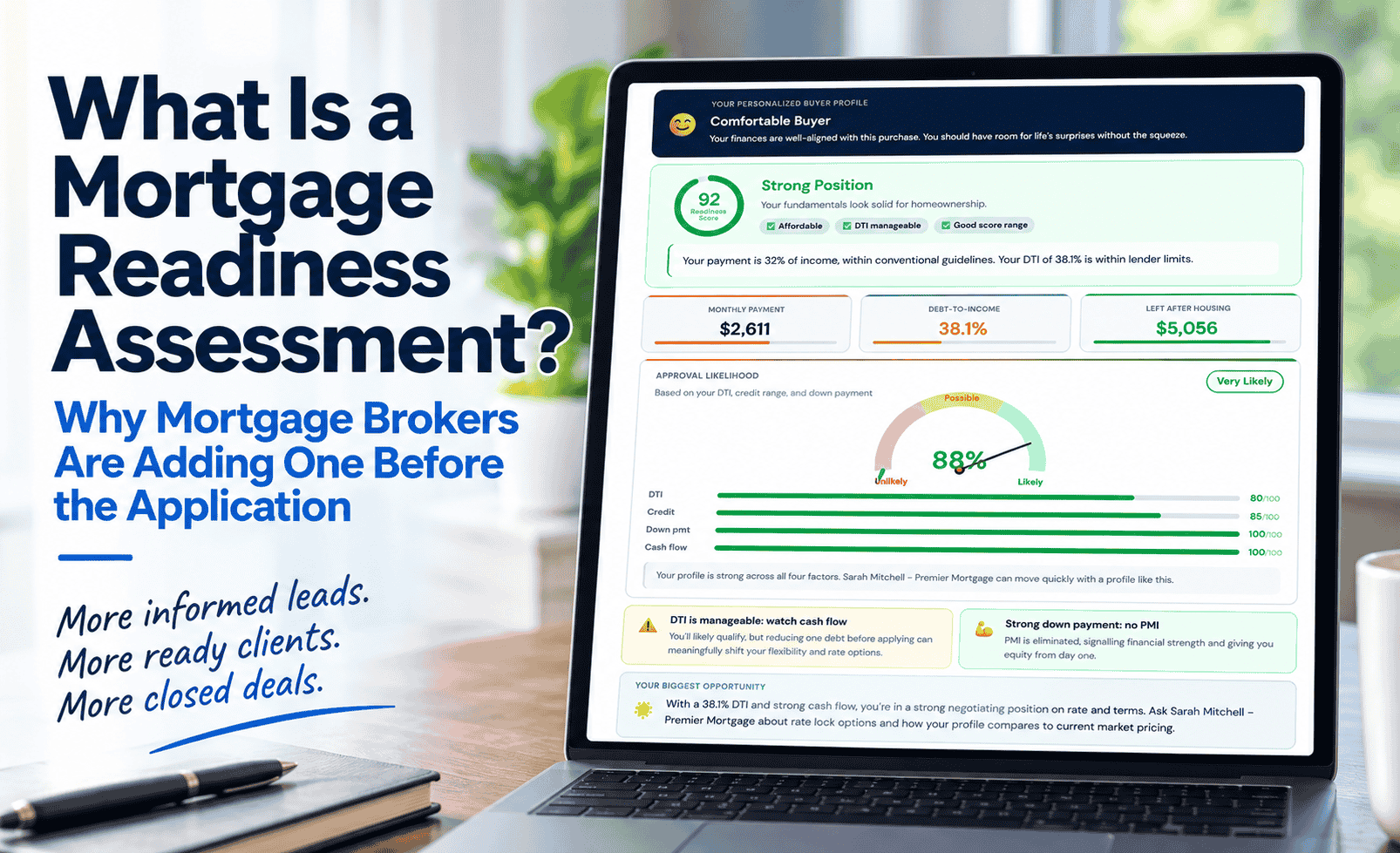
A mortgage readiness assessment is an educational tool that a borrower completes before starting a formal mortgage application. It uses self-reported financial information to produce a directional picture of where the borrower stands: their estimated monthly payment, their debt-to-income ratio, their credit score range, and whether their overall financial profile appears to be in a position that typically supports a mortgage application. The output is informational. It is not a lending decision, a pre-qualification, or a pre-approval.
For mortgage brokers, a readiness assessment serves a different purpose than it does for the borrower. It sits on the broker’s website and gives every visitor a way to understand their own situation before they reach the Apply Now button. The visitors who work through the assessment and see that their numbers look strong continue to the application. The visitors whose numbers suggest they are not yet ready receive useful context and a prompt to speak with the broker directly. The result is that the borrowers who reach the application have already worked through their own financial picture and decided to continue.
A mortgage readiness assessment is an educational step that gives a borrower a directional picture of their mortgage readiness based on self-reported financial inputs, without pulling credit, making a lending determination, or constituting a pre-qualification or pre-approval of any kind.
What a Mortgage Readiness Assessment Is
A mortgage readiness assessment is an educational self-service tool. The borrower provides a small set of financial inputs: their target home price, estimated down payment, household income, existing monthly debts, credit score range, and loan type preference. The tool uses those inputs to calculate an estimated monthly payment and debt-to-income ratio, and produces a directional readiness picture: a signal about whether the borrower’s numbers appear to be in a range that typically supports a mortgage application, and which factors, if any, may need attention first.
A mortgage readiness assessment is designed to be completed quickly without requiring extensive preparation. The borrower provides self-reported estimates rather than verified financial documents. The output is an educational starting point, not a professional assessment of creditworthiness.
On a broker’s website, the assessment typically appears before the application. A visitor who wants to know whether they are ready to apply works through the assessment, sees their numbers, and then decides whether to continue to the broker’s existing application system or to reach out to the broker for guidance first.
What It Is Not
Understanding what a mortgage readiness assessment is not is as important as understanding what it is, particularly for brokers considering how to describe and frame the tool on their site.
| It is not | Why |
|---|---|
| A pre-qualification | Pre-qualification is generally a lending assessment conducted within a lender or broker’s workflow that evaluates a borrower’s financial situation in relation to specific loan programs. The process and information used can vary by lender and jurisdiction. A readiness assessment uses self-reported inputs and makes no lending determination. |
| A pre-approval | Pre-approval generally involves a more formal review of the borrower’s financial information and often includes documentation and a credit inquiry. Specific requirements and terminology vary by lender and workflow. A readiness assessment involves none of this formal review. |
| A credit check | No credit inquiry of any kind is made. The borrower self-reports their approximate credit score range. |
| A mortgage calculator | A payment calculator answers one question: what is the estimated monthly payment? A readiness assessment evaluates multiple factors together and produces a broader directional picture. |
| A guarantee of eligibility | The output is based on self-reported, unverified information. Actual loan eligibility depends on a complete application, verified documentation, and formal underwriting. |
| A lending decision | No mortgage professional reviews the inputs. No underwriting guidelines are applied. The output is informational only. |
Any mortgage readiness assessment deployed on a broker website should be clearly labeled as an educational tool and should carry an appropriate disclaimer making clear that the output is informational and not a lending decision, pre-qualification, or pre-approval. Brokers should review the tool’s wording, workflow, and data handling with appropriate compliance or legal counsel for their jurisdiction and license type.
What Information It Considers
A mortgage readiness assessment typically considers four categories of financial information, all of which the borrower can provide from memory without preparing any documents.
Estimated payment factors: Target home price, estimated down payment, approximate interest rate, and loan term. These four inputs produce an estimated monthly payment for the principal and interest portion of the loan.
Income and debt position: Household gross monthly income and existing monthly debt obligations (car payments, student loans, credit card minimums, and similar). Combined with the estimated housing payment, these produce an estimated back-end debt-to-income ratio.
Credit score range: The borrower’s approximate credit score range, self-reported without a formal credit pull. Different loan programs have different minimum requirements, and the credit range gives a directional signal about which programs the borrower may be positioned for.
Down payment position: The estimated down payment as a percentage of the purchase price. A borrower who has the minimum down payment saved is in a different position from one with additional funds available for closing costs and reserves, and the assessment can surface that difference as a directional signal worth discussing with the broker.
None of these inputs are verified. The assessment is explicit that its output is based on self-reported estimates and should be treated as a starting point for a conversation with the broker, not as a determination of mortgage eligibility.
What a Borrower Learns From It
A borrower who completes a mortgage readiness assessment receives a set of educational outputs that give them more context about their situation than they had before. These typically include:
- Estimated monthly payment: Based on their target price, down payment, rate, and term. Not a quote or a guaranteed rate, but a directional estimate the borrower can use to think about affordability.
- Estimated debt-to-income ratio: The combined picture of their housing costs and existing debts relative to their income. DTI is one of the factors lenders consider, and seeing their own estimated DTI gives the borrower useful context about whether their debt load is likely to be a factor in their application.
- A directional readiness signal: An indication of whether their numbers appear to be in a range that typically supports a mortgage application, or whether there are specific factors worth addressing first. This is not a pass or fail determination. It is an educational signal.
- A clear next step: Either a path to the broker’s existing application for borrowers whose numbers look strong, or a prompt to speak with the broker directly for borrowers whose numbers suggest there are factors worth discussing first.
What the borrower does not receive is a lending decision, a pre-qualification letter, or any document they can present to a seller or real estate agent. The assessment gives them educational context to help them decide whether to proceed, not a formal indication of what they can borrow.
Why Mortgage Brokers Are Adding One Before the Application
The traditional mortgage broker website funnel sends every visitor to the same Apply Now button regardless of where they are in their readiness. A first-time researcher who arrived from a Google search about mortgage rates and a referred client who just left a real estate agent’s office see the same form, at the same stage of the same process. The application does not distinguish between them. Neither does the broker, until they start working the file.
A mortgage readiness assessment sits between the site and the application and gives every visitor a way to understand their own situation first. Brokers who add one before the application describe three practical benefits.
First, the borrowers who reach the application have already worked through their own numbers. They are not encountering their DTI or estimated payment for the first time on the application form. They have seen those numbers, decided the picture looks manageable, and chosen to continue. That can give the broker more context when the borrower reaches the application.
Second, the borrowers who are not yet ready do not simply abandon the form halfway through. They receive a clear picture of what needs attention, and a prompt to speak with the broker directly. That keeps the relationship alive rather than ending it at an incomplete form the broker never hears about.
Third, the assessment can help separate visitors who are ready to take the next step from those who may need more information first. A broker who knows which visitors have already worked through their numbers has a more useful starting point for the first conversation than one who receives every form submission with no prior context.
A mortgage readiness assessment does not replace the application. It prepares the borrower for it. The broker’s application, their existing system, their process: none of it changes. What changes is the context the borrower brings to it.
Where It Sits in the Broker Funnel
A mortgage readiness assessment sits between the broker’s website content and the broker’s application. It is not the first thing a visitor sees, and it is not the last step before the file is worked. It is the step between curiosity and commitment. For brokers, a mortgage readiness tool can provide this assessment directly on the website before the borrower enters the formal application process, functioning as a mortgage readiness check that gives the visitor a directional picture without requiring a formal credit inquiry or broker involvement at that stage.
| Funnel Stage | Tool | What It Does |
|---|---|---|
| Awareness | Website content, calculators | Attracts visitors, answers basic questions, estimates payments |
| Readiness | Mortgage readiness assessment | Gives the visitor a directional picture of their financial position before they apply |
| Application | Broker’s existing application system | Captures a complete application from a borrower who has already worked through their numbers |
| Processing | Broker’s workflow and LOS | The broker works the file with a borrower who arrived with context |
The readiness assessment does not replace the mortgage calculator, the lead form, or the application. It fills the gap between them. A calculator tells the borrower what their payment might be. The readiness assessment tells the borrower whether their overall financial picture appears to support that payment. The application captures the complete record once the borrower has decided to move forward.
MDE Pro is one implementation of a mortgage readiness assessment built specifically for broker websites. It provides the full assessment in about 20 seconds, runs entirely in the visitor’s browser with no data transmitted or stored, and routes visitors whose numbers look strong directly into the broker’s existing application system. It is not a pre-qualification tool. The live demo shows the complete visitor experience from the first question through to the application handoff.
See a Mortgage Readiness Assessment on a Broker Site
MDE Pro runs a full borrower readiness assessment in about 20 seconds. No credit pull, no signup, no data stored. Visitors whose numbers look strong continue directly to your existing application.
View the Live DemoQuestions about adding a mortgage readiness assessment to your broker site? Email services@ournethelps.com